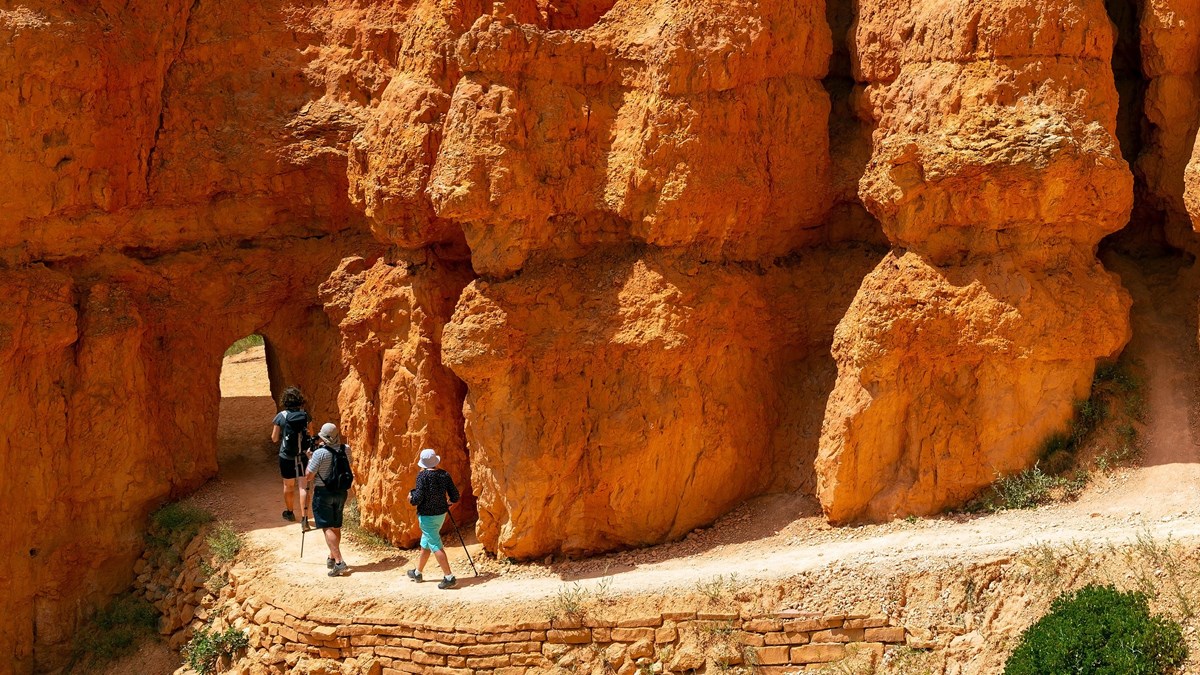
Wall Street (seasonal): Narrow slot canyon with towering walls and Douglas firs rooted in the rock. More dramatic but steeper switchbacks. Closes when ice or snow is present, typically December through March or April.
Guide Duck Creek
Queen’s Garden & Navajo Loop
La randonnée emblématique de Bryce Canyon - 2,9 miles parmi les hoodoos et retour à la crête
En bref
- Distance
- 2.9 miles, loop including the Rim Trail return
- Elevation gain
- 625 ft, per the National Park Service
- Time
- 2 to 3 hours, allowing for photo stops
- Difficulty
- Moderate: well graded, but real climbing above 8,000 feet
- Trailhead
- Sunrise Point to descend Queen's Garden, Sunset Point to climb the Navajo Loop
- Permit
- None. A standard day hike with the park entrance fee
Si vous ne faites qu’une randonnée à Bryce Canyon, c’est celle-ci. Le combo Queen’s Garden et Navajo Loop est le sentier le plus populaire du parc et celui recommandé pour une première visite. Il vous fait descendre sous la crête dans l’amphithéâtre, serpenter entre des corridors de hoodoos et des parois étroites, puis remonter avec tout l’amphithéâtre derrière vous.
How the combo works
The loop connects two trails, Queen's Garden (starting from Sunrise Point) and Navajo Loop (ending at Sunset Point), with a short connector below the rim. Hike it clockwise: descend from Sunrise Point on the Queen's Garden trail, walk the connecting trail at the bottom, then ascend the Navajo Loop switchbacks to Sunset Point. Walk the flat, paved Rim Trail half a mile back to your car at Sunrise Point.
The NPS recommends clockwise for three reasons: the Queen's Garden descent is gentler and puts the amphitheater views in front of you as you go down; ascending the steeper Navajo switchbacks is safer than descending them; and when everyone hikes the same direction, a busy trail feels less congested.
What to expect below the rim
The Queen's Garden descent is the gentler half. You drop along a ridgeline with open views of the amphitheater, passing formations the early explorers named for their resemblance to Queen Victoria and her court. The hoodoos go from distant shapes to arm's-length structures as you descend.
At the bottom, a connector trail links you to the Navajo Loop. This section winds through hoodoo corridors with walls on either side. It is quieter here than at the top and the scale of the formations becomes real: you are walking among towers that are taller than most buildings.
The Navajo Loop ascent has two routes. The Wall Street side passes through a narrow slot with Douglas fir trees growing in the shadows between 200-foot walls. It is the more dramatic option but closes when icy (usually December through March or April). The Two Bridges side stays open year-round and passes Thor's Hammer, the park's most-photographed hoodoo. Either way, the switchbacks are steep and the last stretch to the rim is the part where altitude makes itself felt.
Wall Street vs. Two Bridges
Two Bridges (year-round): Wider trail with views of Thor's Hammer and two natural rock bridges. Open all year. Slightly less steep than Wall Street and better for anyone uneasy with tight spaces or heights.
Seasonal notes
Summer (June to August) gives you the most reliable conditions: all routes open, long days, shuttle running. Afternoon thunderstorms are common but usually pass quickly. Start in the morning to beat heat and crowds.
Spring and fall offer smaller crowds and beautiful light. Wall Street may still have ice into May; fall colors in the surrounding forest add to the drive from Duck Creek. These are our favorite seasons for this hike.
Winter turns the hoodoos into a different landscape. Snow on the red rock is spectacular for photography. Wall Street closes, but Two Bridges stays open. Traction devices (microspikes or similar) are strongly recommended. Shorter days mean earlier starts.
Tips from Duck Creek
- Arrive early. Parking at Sunrise and Sunset Points fills by mid-morning in summer. Leave Duck Creek by 8 AM, or take the free shuttle from the shuttle station to skip the parking stress.
- Park at Sunrise Point. If you are hiking clockwise (recommended), park at Sunrise Point so you end the loop with a short Rim Trail walk back to your car instead of an uphill return.
- Morning light is best. The amphitheater faces east, so morning light hits the hoodoos directly and makes the colors pop. By afternoon the amphitheater is in shadow.
- Wear hiking boots. The switchbacks are sandy and the rock steps are uneven. The NPS says inappropriate footwear is the number one cause of rescues at Bryce. Lug soles and ankle support make the climb out much easier.
- Bring water and a layer. At 8,000 feet, you dehydrate faster than expected. Carry at least a liter per person. Mornings can be cool even in summer, and a light jacket is worth having.
- Check Wall Street status. If you want the Wall Street route, confirm it is open on the NPS conditions page before you go. The Two Bridges side is always a good alternative.
Pairing with other activities
After the combo, walk the Rim Trail to Inspiration Point and Bryce Point for additional viewpoints without dropping below the rim again. If you still have energy, the scenic drive south to Rainbow Point adds quieter overlooks and the short Bristlecone Loop at the end of the road.
Back at Duck Creek, pair a Bryce day with something easier the next day: a morning at Aspen Mirror Lake, a drive to Cedar Breaks, or a rest day with village dining and a walk on the property. Check our rooms and cabins to build the stay around the trip.
March 2026
Why trust this guide
We recommend this hike to nearly every guest who asks about Bryce Canyon. Trail conditions and Wall Street closures change seasonally, so always check the NPS resources before you commit to a route.
Questions sur Queen’s Garden & Navajo Loop
Les questions les plus fréquentes avant de partir sur la boucle classique.
Combien de temps prend le combo Queen’s Garden et Navajo Loop ?
La plupart des gens mettent 1,5 à 2,5 heures pour la boucle de 2,9 miles, selon le rythme et les arrêts photo.
Dans quel sens faut-il faire la boucle ?
Dans le sens horaire: descente par Queen’s Garden depuis Sunrise Point, puis montée par Navajo Loop vers Sunset Point.
Wall Street est-elle toujours ouverte sur le Navajo Loop ?
Non. Wall Street ferme quand il y a de la glace ou de la neige; Two Bridges reste ouverte toute l’année.
Cette randonnée est-elle adaptée aux enfants ?
Oui pour les enfants plus grands capables de marcher une randonnée modérée. Les tout-petits en poussette ne peuvent pas la faire.
Faut-il un permis pour Queen’s Garden et Navajo Loop ?
Non. C’est une randonnée standard de journée avec le seul frais d’entrée du parc.
Séjournez ici, randonnez les hoodoos demain
Réservez votre chambre ou votre cabane au Duck Creek Village Inn - soirées fraîches à 8 400 pieds après une journée sous la crête à Bryce.