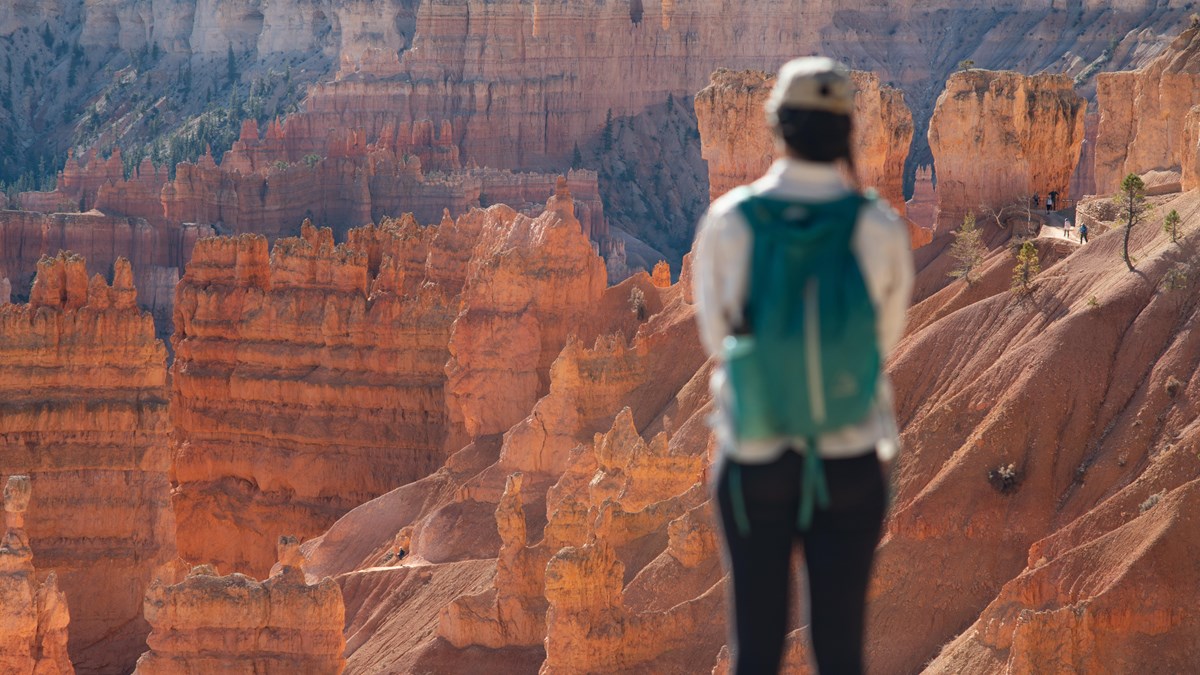
Fairyland Point: 1-mile spur just inside the entrance, before the fee booth. The northernmost rim viewpoint in the park, looking over Fairyland Canyon and the northern Paria Valley. Trailhead for the Fairyland Loop, with a picnic table and 20 parking spaces. No shuttle stop, and the spur road closes to vehicles for the winter once plowing begins.
Which stops to prioritize
One to two hours: stay in the amphitheater. Start at Bryce Point, then Inspiration, then Sunset, and walk the paved half mile of rim to Sunrise Point. That is the park’s greatest hits in a very small footprint.
Three to four hours: drive straight to Rainbow Point, walk the Bristlecone Loop, and take Black Birch, Ponderosa, Agua Canyon, Natural Bridge, Farview and Swamp Canyon on the way back. Finish in the amphitheater in the late afternoon. This is the version we send most guests out with, and it is the only version that shows you both halves of the park. Add a hike from our Bryce Canyon hikes guide if you have the legs for it.
A full day: run south first while the road is empty, then hike the Queen’s Garden and Navajo Loop combo from the amphitheater late morning, and walk the Rim Trail in the afternoon. Roughly six or seven hours in the park, plus an hour each way from Duck Creek.
Light, timing, and where the crowds are
The amphitheater faces east, so morning is when the hoodoos are lit head-on and glowing. By mid-afternoon the bowl falls into its own shadow and the color flattens. That argues for the same plan as the traffic does: south early, amphitheater when you get back.
The park does not publish a single "best" sunset overlook, but it does say Paria View, facing southeast toward the White Cliffs and Navajo Mountain, is wonderful at sunset, and Bryce Point’s southern angle holds light late. Both Sunrise and Sunset Points were named as marketing, not as astronomy, and the park says plainly that each is spectacular at either end of the day.
Parking is the real constraint, not the road. Sunset Point has 115 spaces and Sunrise 113, and both fill on summer mornings. Agua Canyon has seven. If you arrive at a full lot in the amphitheater, take the shuttle instead of circling; if you arrive at a full lot in the south, drive on and catch it on the way back.
Winter and shoulder season
The park never closes, and the main road is plowed. What happens after a storm is that the road beyond Mile 3 closes temporarily while crews clear the higher southern section, usually for a day or more, depending on how much fell. The amphitheater stays reachable; Rainbow Point may not be.
Two spur roads close for the whole season once snow removal begins: the 1-mile road to Fairyland Point and the 0.3-mile road to Paria View. Both stay open to skiers and snowshoers, which is why the park closes them. Everything else on the drive stays drivable between storms.
Underfoot is the other winter story. The park warns that popular trails and even parking lots and paved areas get icy enough that steep sections cannot be crossed safely without traction devices. Bring microspikes if you plan to walk anything beyond the railing. Check today’s Bryce conditions before you leave, and our road-conditions page for the drive over Cedar Mountain.
Navette ou voiture ?
La navette gratuite du parc, d’avril à octobre, couvre seulement la zone de l’amphithéâtre.
Pour les belvédères du sud, vous avez besoin de votre propre véhicule.
Les véhicules de plus de 20 pieds sont restreints sur le secteur de l’amphithéâtre pendant la saison de la navette.
How the day flows from Duck Creek
- Bryce is about an hour from Duck Creek Village Inn, south on UT-14 to US-89 and east on UT-12. A workable summer day looks like this:
- 7:00 AM: Leave the inn with a full tank; fill up in the village before you drop off the mountain.
- 8:00 AM: Through the entrance and straight past the amphitheater turnoffs. Do not stop yet.
- 8:45 AM: Rainbow and Yovimpa Points. Walk the Bristlecone Loop while the air is still cold.
- 10:00 AM to 12:30 PM: Work north: Black Birch, Ponderosa, Agua Canyon, Natural Bridge, Farview and Piracy, Swamp Canyon. Every one a right turn.
- 12:30 PM: Lunch at the lodge or from the cooler at a picnic table.
- 1:30 PM: Amphitheater: Bryce Point, Inspiration, Sunset, and the paved rim walk to Sunrise.
- 4:00 PM: Mossy Cave on UT-12 on the way out, if anyone still has energy.
- 5:30 PM: Back at Duck Creek Village Inn, 8,400 feet and about twenty degrees cooler than the valley.
Practical details
- Entrance fee
- $35 per vehicle for 7 days, $30 motorcycle, $20 on foot or bike; America the Beautiful pass accepted. The park is cashless, cards only
- International visitors
- Non-US residents aged 16 and up pay a $100 nonresident fee on top of the entrance fee, unless admitted with an Annual or America the Beautiful pass
- Fuel
- Fill up before you go. The park’s own services run to a lodge, a general store and two campgrounds, not a gas station
- Altitude
- Around 8,000 ft through the amphitheater, over 9,000 ft at the south end; take the first day easy
- Restrooms on the drive
- Visitor Center, Sunset Point, Farview Point, and Rainbow Point
- Dogs
- Paved surfaces and paved viewpoints only, 6-foot leash, never on the shuttle, and never at Piracy Point
- Bikes
- A 5-mile shared use path links the Shuttle Station to the Visitor Center, Sunrise, the lodge, Sunset and Inspiration Point; e-bikes under 750 W allowed, and the shuttle carries two bikes
Plan du séjour
A scenic drive day pairs naturally with a slower day closer to home: Cedar Breaks in the morning, or an afternoon on the property. See staying near Bryce Canyon for how the drive from Duck Creek compares with the gateway towns, and where to eat near the park if you would rather not pack a cooler.
You get the park at its best hours without paying gateway-town rates, and you come home to cool mountain evenings at 8,400 feet instead of a parking lot.