A 700-acre trout lake at 9,000 feet, 15 minutes from the inn, stocked every year and iced over by mid December
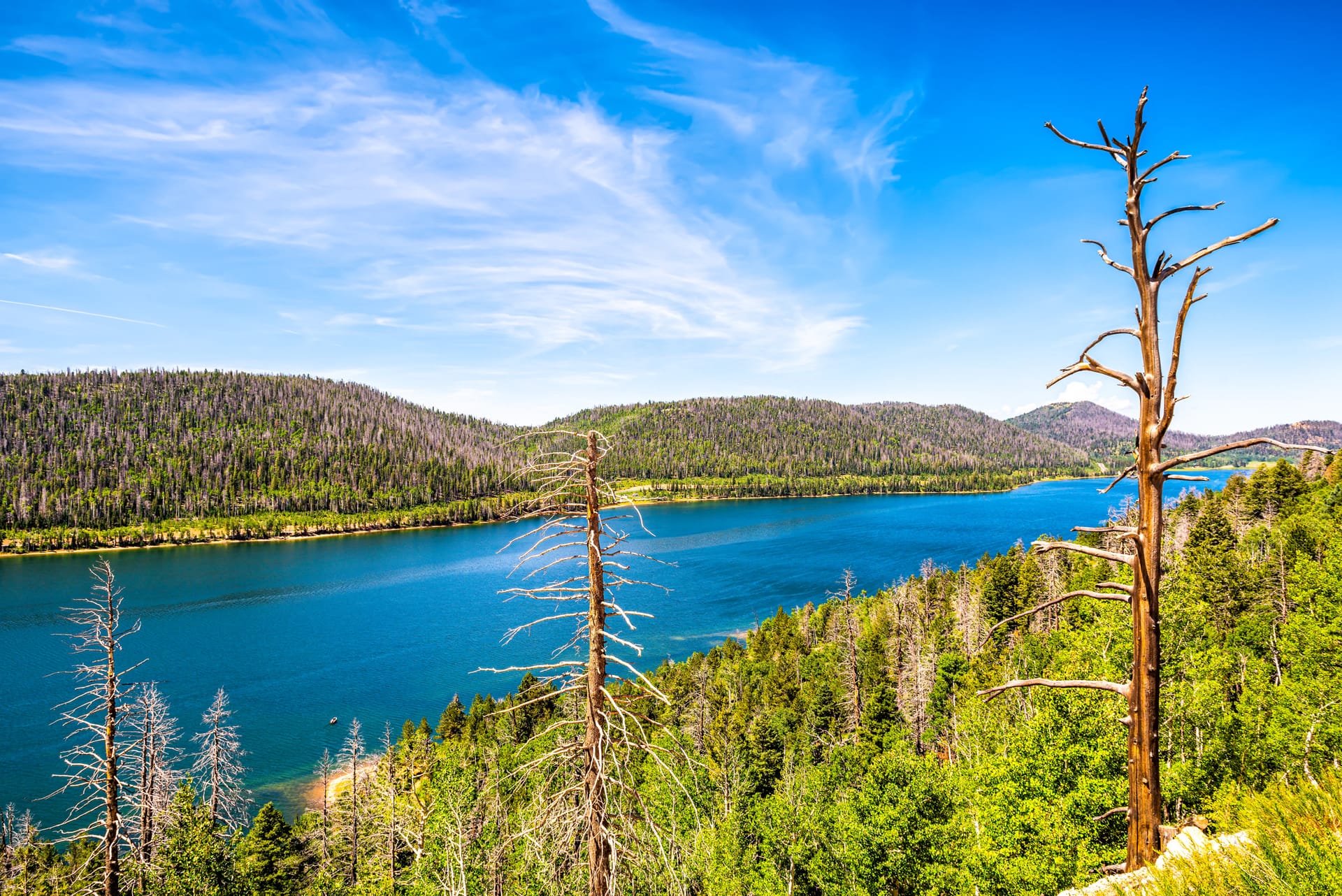
Navajo Lake is the biggest water close to Duck Creek Village: about 3 miles long, half a mile wide, roughly 700 acres when full, and never deeper than about 25 feet. It sits at 9,035 feet behind a lava flow with no surface outlet, 15 minutes west of the inn on Highway 14. The Utah Division of Wildlife Resources has stocked it every year since 2013, and since a full reset of the fishery in 2021 the lake holds rainbow trout, tiger trout, splake, cutthroat and a growing crop of tiger muskie instead of the Utah chub that had taken it over.
This page covers the fishing itself: what is in the lake and how it got there, the live stocking record, where to fish from shore or a boat, the rules that are specific to this lake, and the winter, when the road goes unplowed and the ice fishing is a snowmobile trip. For the lake as a whole, the campgrounds and the sinkhole story, start at our Navajo Lake page; for the other stocked waters around the village, the Duck Creek fishing guide compares all four.
Fishing at a glance
Species
regenboogforel en splake most years, plus tiger trout, brook trout, cutthroat and tiger muskie in the stocking record
Limit
Statewide 4 trout, with a Navajo Lake special rule: only 1 trout or Arctic grayling over 22 inches, any species
License
Utah fishing license required from age 12; two poles allowed statewide
Stocking window
About 8 plants a season, usually May 24 to August 26; the first 2026 plant went in on April 28
Boats
Motorized and paddle craft; primitive landing at Navajo Lake Campground, paved ramp at the lodge ($10); Mussel-Aware course for every craft
Ice-over
Early to mid December in a typical year (DWR); road unplowed, so winter access is by snowmobile
From the inn
About 8 miles, 15 minutes: west on Highway 14 to Navajo Lake Road, then 2.5 paved miles to the campground
What is in the lake now
By 2021 the Utah chub made up more than 90 percent of the fish in Navajo Lake. DWR treated the whole lake with rotenone in October 2021, then wrote a new management plan with local anglers in early 2022. The plan puts rainbow trout in for family fishing, tiger trout, splake and tiger muskie in as predators and trophy fish, and Arctic grayling in for overwinter survival when oxygen runs low under the ice. As of May 2025 the grayling had not yet been stocked because of hatchery limits, which is why the special rule names a fish you probably will not catch yet.
The stocking record since 2002 shows regenboogforel every year, splake in most years, bronforel en tijgerforel in about half of them, tijgersnoek en cutthroatforel in a few. A typical season is about 8 plants and about 34,000 fish between May 24 and August 26. The largest single plant on record was 24,924 regenboogforel on August 21, 2018.
Size at stocking tells you what to expect on the line. In 2026 the rainbows and tiger trout went in at catchable size, about 9 to 10 inches, in late April and May. The tiger muskie went in at about 5 inches in late May and the splake at under 3 inches in June; both are there to grow in the lake, not to be caught this year. The cutthroat plants in June and July were 14 to 15 inch fish. DWR's May 2025 report called the summer outlook "fair to good," with catchable 10-inch rainbows and tiger trout, and splake up to 10 pounds have come out of this lake in the past.
Local anglers used to catch chub on worms here and fish them as bait. That was the old lake. The reset changed the food chain, so treat any advice about chub as history rather than a plan.
Visuitzet per 2 september 2026
Laatst uitgezet:Regenboogforel — 2 september 2026 (1.890 vissen · ~11.2″)
Elk jaar uitgezet sinds 2013. Meestal 8 keer per seizoen, ongeveer van 24 mei tot 26 augustus. Meestal regenboogforel, splake en bronforel.
Dashed fish markers are the shore stretches with easy walking access, not catch reports. Boat launches and campgrounds are on too; toggle trails and landmarks in the legend.
Where and how to fish it
From shore. The easiest bank is inside Navajo Lake Campground, about 3.5 paved miles down Navajo Lake Road from Highway 14, where the sites sit on the water and 11 walk-in tent sites put you a few steps from it. The road wraps the east end past the dike, passes Spruces at 2.5 miles, reaches the lodge at 4, and ends past Te-Ah near the west end, with shoreline put-ins along the way. The six shore stretches we send guests to are marked on the map below and described on the lake page. The campgrounds open in late May and close in early September; the shore itself fishes until the snow.
By boat. Motorized boats are allowed. The Forest Service lists motorized-boat angling, the lodge rents motorboats and pontoons, and no horsepower or wake restriction is published for the lake. Launch at the primitive dirt landing inside Navajo Lake Campground (small boats), at the paved ramp at Navajo Lake Lodge ($10, free for cabin guests and slip renters), or carry a kayak or paddleboard to the shore. Afternoon wind is normal on the plateau, so the calm hours for trolling or paddling are the morning ones.
Before any craft touches the water. Utah's 2026 aquatic invasive species rules require every person who launches any watercraft, kayaks, canoes and paddleboards included, to complete the free annual Mussel-Aware Boater course and carry proof. Motorized boats also pay the annual AIS vessel enrollment fee ($20 for residents, $25 for nonresidents) and display the decal. Two poles are allowed statewide, and if you fish through the ice, the hole may not be wider than 18 inches.
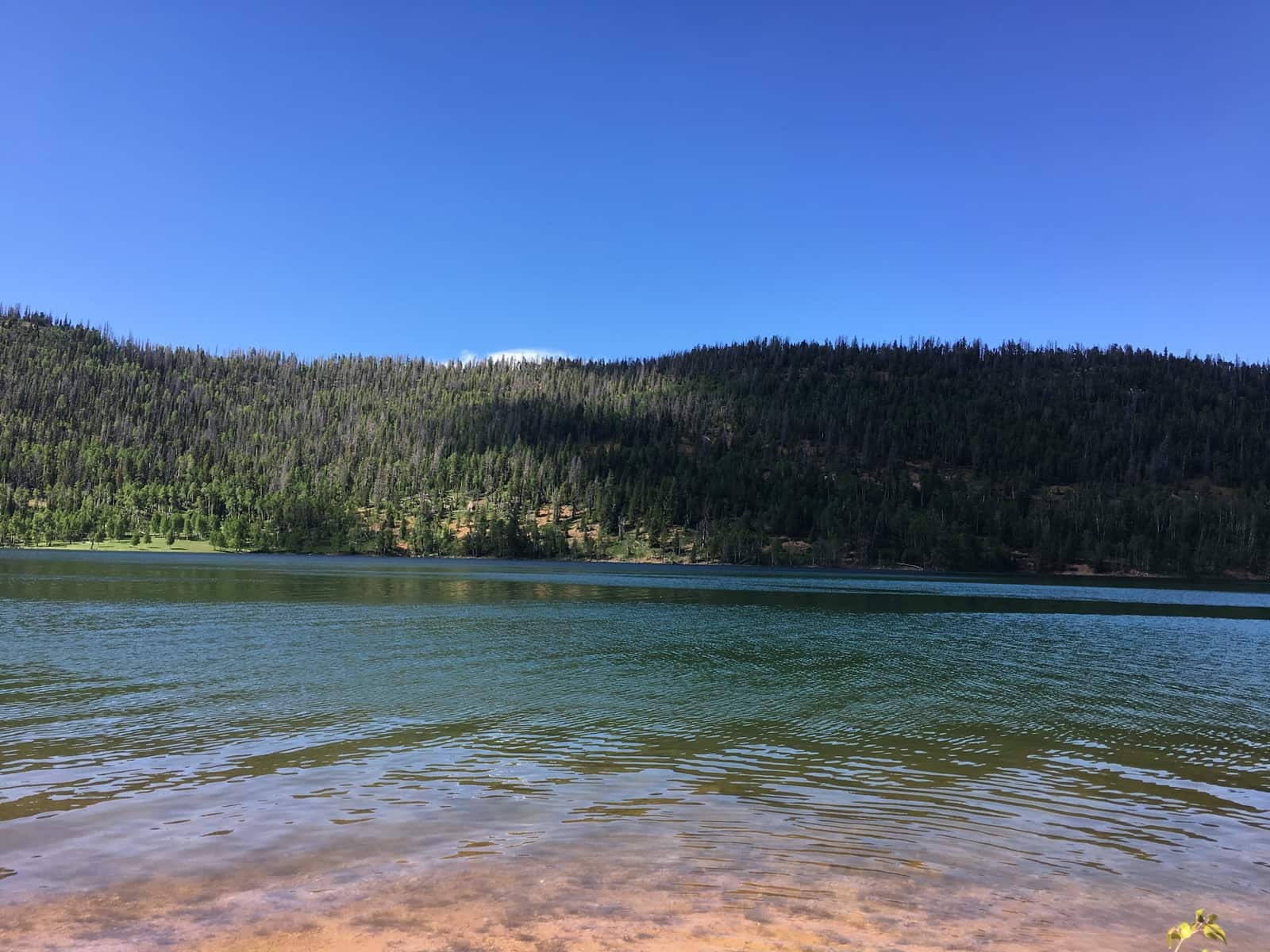
Navajo Lake from the south shore near the campground. The lake is shallow all the way across, about 25 feet at most.
Boat rentals at Navajo Lake Lodge
Navajo Lake Lodge, on the south shore about four miles in, dates to 1927 and runs a general store, boat rentals and a fish cleaning station. These are the posted prices as of September 2026. Seasons and availability change, so call the lodge at (702) 646-4197 to confirm before you drive out. Life jackets are included, the renter has to operate the boat, and beaching a rental boat is prohibited.
Rental
All day
Four hours
Two hours
24-ft pontoon
$335
$200
18-ft pontoon
$285
$175
Boat and motor
$125
$95
$80 (two-hour minimum)
Paddleboard or kayak
$60
$40
Boat slip
$55 a day
Ramp fee $10, free for lodge cabin guests and slip renters.
Regulations
Navajo Lake follows the statewide rules with one special regulation. The 2026 Utah Fishing Guidebook, Kane County section, states it this way:
Limit 1 trout or Arctic grayling over 22 inches, regardless of species (goes toward the statewide trout limit).
2026 Utah Fishing Guidebook, Navajo Lake (Kane County)
Trout limit: 4 trout statewide, and at Navajo Lake only 1 of them may be over 22 inches, whatever the species
Tiger muskie: the statewide harvest limit is 1 fish and it must be over 40 inches; DWR asked anglers to release every tiger muskie here in 2025
Proposed for 2027: in August 2026 DWR proposed allowing one tiger muskie of any size at Navajo Lake in the 2027-28 guidebook. It is a proposal until the Wildlife Board adopts it; the Board takes it up on September 17, 2026
License: required from age 12, sold online at wildlife.utah.gov; buy it before you lose cell service on the mountain
Poles and ice holes: two poles statewide; an ice-fishing hole may not exceed 18 inches
Watercraft: the free annual Mussel-Aware Boater course for every launch, plus the AIS fee and decal for motorized boats
DWR says Navajo Lake typically ices over in early to mid December, and at about 25 feet deep it freezes early. The catch is getting there. Navajo Lake Road is not plowed, the campgrounds have been closed since early September, and DWR's own winter report says to bring a snowmobile. The practical route is the Cedar Mountain snowmobile complex: the trail from the Duck Creek trailhead to Navajo Lake runs 9.2 miles, and our snowmobile page covers the trailhead, the complex and where to rent a sled. Deer Hollow Winter Recreation Area, 4 miles west of the village, has a ski trail to an overlook above the lake if you want to see the ice without fishing it.
Splake are the winter draw. The lake gets them in most stocking years, they grow well here, and Visit Utah's description is that the ice fishing "can be very good for splake, but access usually requires a snowmobile." DWR rates the winter fishing fair to good, depending on access. Remember the 18-inch limit on hole size and the two-pole rule, and that the one-over-22-inches rule applies in winter as much as in July.
A shallow, wind-exposed lake at 9,000 feet asks for the same care as any other ice. Utah State Parks publishes the checklist we follow:
At least 4 inches of clear ice to walk on, 6 or more before you bring a snowmobile or ATV onto it
Clear ice is stronger than cloudy or snow-covered ice; drill test holes as you go
Fish with a partner, spread the group out, and carry ice picks and a throw rope
Stay away from inlets and springs, where moving water thins the ice
Treat March and April ice as deteriorating no matter how thick it measured in February
If the snowmobile is the problem, Panguitch Lake is the drive-to alternative. Its road is paved and plowed, and the winter route from the village takes about 1 hour 15 minutes. Our Panguitch Lake page has the detail, the winter guide has the drive when the summer shortcut is closed, and the snow report shows what the plateau looks like this week.
Season by season
Spring, after ice-out. The first plants of the year go in as soon as the trucks can reach the water. In 2026 that was April 28, 2026, the earliest date in the record, with catchable rainbows and cutthroat followed by tiger trout in early May; the median first plant across all years is May 24. The stocking trucks reach the lake weeks before the campgrounds open in late May, so early season is shore fishing and cartop boats. Fresh 10-inch rainbows take PowerBait, worms and small spinners along the campground shore.
Summer. Everything is open from late May, and the plants keep coming into August. Fish the mornings: the wind builds most afternoons, and from July to early September afternoon thunderstorms are common on what is the highest, most exposed water near the village. Get off the lake when you hear thunder. Estimated July highs at the lake are about 75°F with lows near 45°F, interpolated from the NOAA normals at Alton and Brian Head, so bring a layer for the dawn session. Splake sit deeper than the rainbows; let a jig or spoon sink before you retrieve.
Fall. The last plant usually lands around August 26, the campgrounds close in early September, and the water cools. The aspens on the byway turn in the last week of September, and the lake road stays open until the snow closes it.
Winter. Ice by mid December, access by snowmobile, splake through the ice. Estimated January highs at the lake are about 33°F with lows near 12°F, from the same two-station interpolation.
Whatever the month, check our Duck Creek fishing report the morning you decide where to go. It lists the most recent plant at every water near the village straight from the state stocking log.
Where to stay
Duck Creek Village Inn is about 8 miles and 15 minutes from the campground shore, so a dawn start on the lake is an easy one. Our cabins have full kitchens for cooking what you keep; our rooms have a mini fridge and a coffee bar. Clean your fish at the lodge's cleaning station on the lake rather than in the room. Our stay near Navajo Lake page lays out the trip, and if the lake is only part of the plan, Cascade Falls, where the lake water reappears out of the cliff, is a 1.1-mile round trip a few minutes down the road.
September 2026
Why trust this guide
We are innkeepers who fish this lake, not biologists. The special regulation and limits come from the 2026 Utah Fishing Guidebook, the stocking history and the live block are computed from the DWR stocking record, the ice-over date and the tiger muskie proposal from DWR reports and news, the rentals from Navajo Lake Lodge's posted prices, and the ice safety list from Utah State Parks. Rules, plants and ice change every season, so verify with the sources below before you drive.
Rainbow trout, tiger trout, splake, cutthroat trout and tiger muskie, with brook trout in the stocking record from earlier years. The state reset the lake with rotenone in October 2021 after Utah chub made up more than 90 percent of the fish, and the 2022 management plan calls for rainbows for family fishing, tiger trout, splake and tiger muskie as predators and trophy fish, and Arctic grayling, which had not yet been stocked as of May 2025.
Do you need a license to fish Navajo Lake?
Yes. Utah requires a fishing license from age 12, sold online at wildlife.utah.gov. Buy it before you leave Cedar City or the village, because cell service on the mountain is unreliable. Two poles are allowed statewide.
What is the limit at Navajo Lake?
Four trout, the statewide limit, with a Navajo Lake special rule from the 2026 guidebook: only one trout or Arctic grayling over 22 inches, regardless of species, and it counts toward the four. Tiger muskie are limited statewide to one fish over 40 inches.
When is Navajo Lake stocked?
In most years the first plant goes in around May 24 and the last around August 26, about 8 plants and roughly 34,000 fish a season. In 2026 the first rainbows went in on April 28. The live block on this page and our Duck Creek fishing report show the most recent plant from the state stocking log.
Can you ice fish Navajo Lake?
Yes, once it freezes, which DWR says is typically early to mid December. Navajo Lake Road is not plowed, so winter access is by snowmobile, most often the 9.2-mile Cedar Mountain complex trail from the Duck Creek trailhead. Splake are the main winter catch. Holes may not exceed 18 inches, and Utah State Parks recommends at least 4 inches of clear ice to walk and 6 or more for a snowmobile.
Are there tiger muskie in Navajo Lake?
Yes. DWR stocks tiger muskie as a predator under the 2022 plan; the 2026 plant was about 4,800 fish at 5 inches in late May. The statewide limit is one over 40 inches, DWR asked anglers to release all of them in 2025, and in August 2026 the agency proposed a one-of-any-size limit for Navajo Lake in the 2027-28 guidebook, which is a proposal until the Wildlife Board acts on it.
Can you use a motor boat on Navajo Lake?
Yes. Motorized boats are allowed, the Forest Service lists motorized-boat angling, and Navajo Lake Lodge rents motorboats and pontoons. No horsepower or wake restriction is published. Launch at the primitive landing in Navajo Lake Campground or the lodge ramp ($10). Every craft, kayaks included, needs the free annual Mussel-Aware Boater course, and motorized boats need the AIS enrollment fee and decal.
How deep is Navajo Lake?
About 25 feet at the deepest. The lake is about 3 miles long and half a mile wide, roughly 700 acres when full, at 9,035 feet. The shallow depth is why it freezes early in December and why winterkill and low oxygen were problems before the 2021 reset.
Where is the best shore fishing at Navajo Lake?
Navajo Lake Campground, 2.5 paved miles from Highway 14, where the sites and 11 walk-in tent sites sit on the water and there is a primitive boat landing. The road continues along the south shore to Spruces, Te-Ah and the lodge with shoreline put-ins along the way. The campgrounds close in early September; the shore fishes until the snow.
How far is Navajo Lake from Duck Creek Village?
About 8 miles and 15 minutes: west on Highway 14 about 4 miles to Navajo Lake Road (Forest Road 053), then about 3.5 paved miles to Navajo Lake Campground. From Cedar City it is 25 miles east on Highway 14, about 40 minutes.
Fish the Lake, Sleep in the Village
Rooms and cabins at Duck Creek Village Inn are 15 minutes from the Navajo Lake shore, with a full kitchen in every cabin for the trout you keep.