Groomed ski loops, snowshoe trails, and two overlooks on the rim above Navajo Lake, four miles from the village
Deer Hollow is the closest groomed cross-country skiing to the inn, and the easiest winter outing in the area to get right. The Forest Service keeps more than 1,300 acres of meadow and spruce-aspen forest closed to snowmobiles, the Cedar Mountain Nordic Ski Club grooms the loops, and the plowed lot sits right on Highway 14 four miles west of Duck Creek Village. You can finish breakfast at the inn and be clipping into skis fifteen minutes later.
The trails climb gently from the parking area at 9,510 feet to a pair of overlooks on the plateau rim, one above Navajo Lake and one over the black lava field, then fan out into a network of ski-only loops named for the rock layers under your feet. Summer is quieter: no grooming, no signs to speak of, just wildflower meadows and aspen groves that most visitors drive past on the way to the lake.
At a glance
Drive from the inn
About 6 miles west on Highway 14 near milepost 23, roughly 10 minutes
Elevation
9,510 ft at the lot, 9,600 ft at the Navajo Lake Overlook
Ski season
Groomed from about mid-December to mid or late March
Trails
About 23 miles marked, groomed weekly when snow allows
Dogs
Aspen, Boulder, and Pebble trails only
Fat bikes
Boulder and Pebble trails only
Facilities
Plowed loop for 20 to 30 cars, information kiosk, no water
Fees
None listed by the Forest Service; the ski club runs on donations
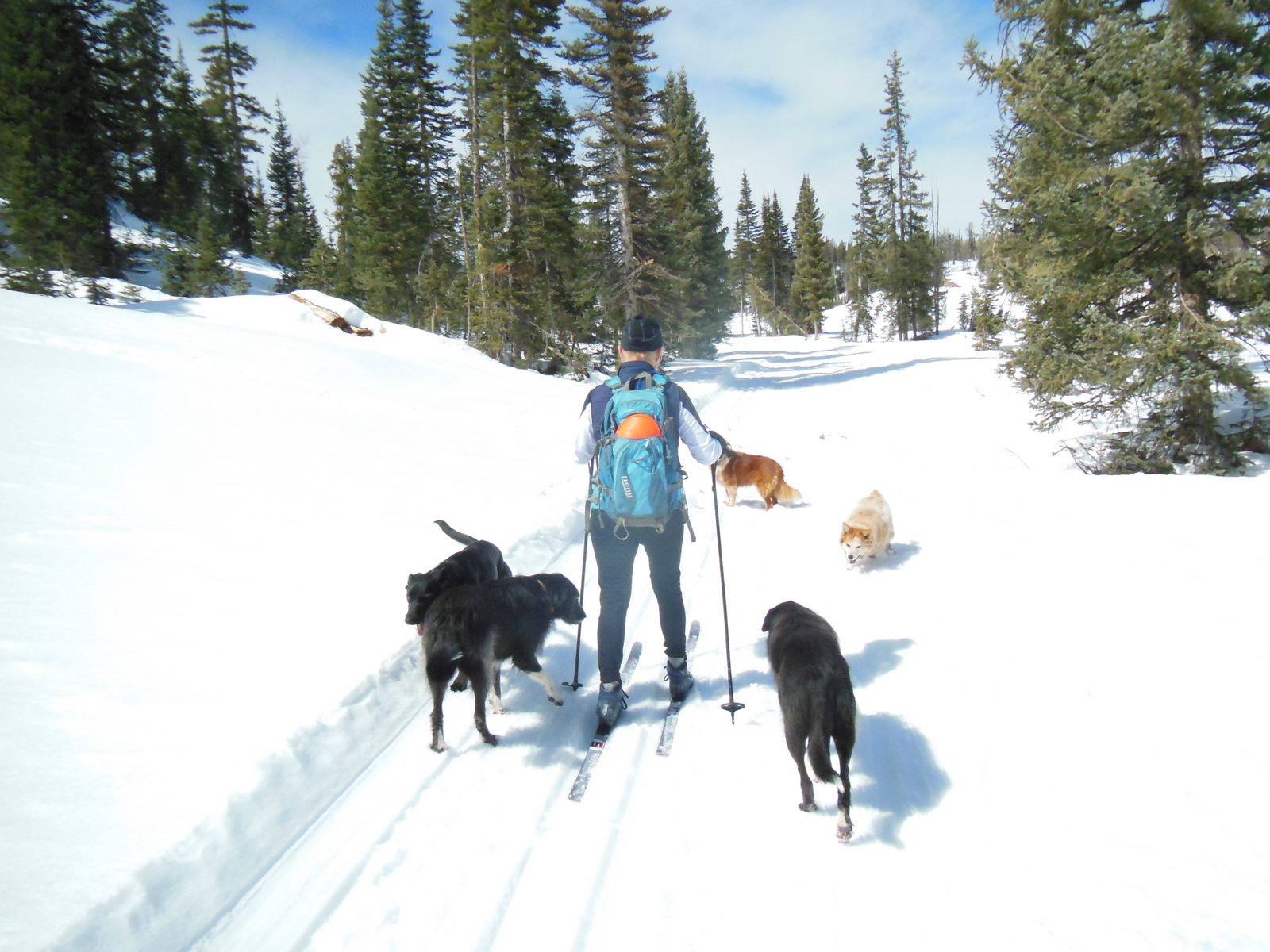
Header photo: a groomed ski trail on the Dixie National Forest, US Forest Service, public domain.
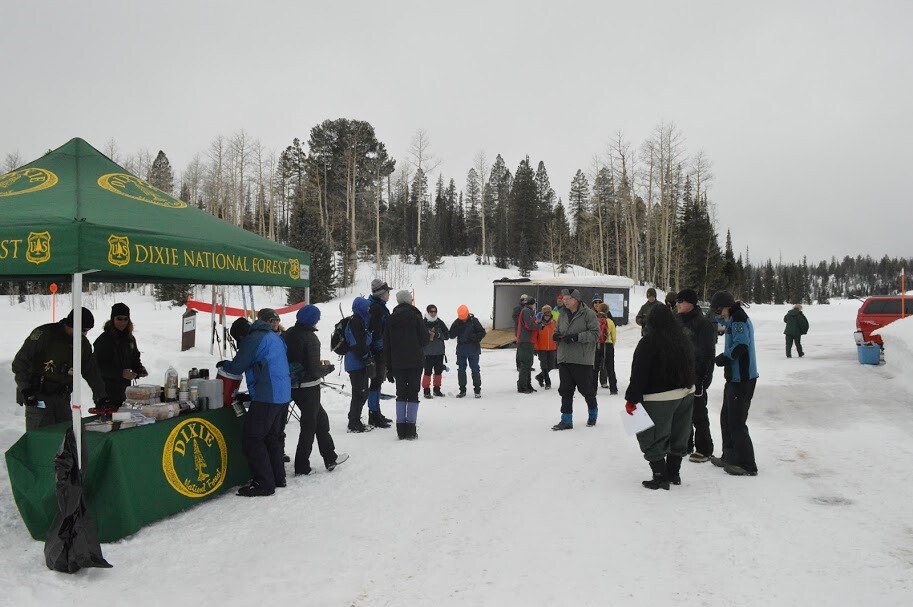
The parking area at the February 2016 dedication of the recreation area. The kiosk with the trail map stands at the far end of the lot. US Forest Service, Intermountain Region · Public domain · via the Forest Service on Flickr
How the trails are marked
Every trail carries a colored marker, and the color tells you who it is for. Match your activity to the color and the whole system makes sense.
Blue: skiers only Set classic track through the meadows. No boots, snowshoes, or bikes.
Yellow: multi-use Skis, snowshoes, and (on Boulder and Pebble) fat bikes. Stay off the classic tracks if you are on foot.
Purple: dog-friendly ski trail The Aspen Trail. Dogs are also allowed on the yellow Boulder and Pebble trails.
The ski-only loops are named for the plateau itself: Claron, for the pink limestone that makes Cedar Breaks; Basalt and Dolomite, for the lava and dolomite that cap it; and three draws called Navajo, Virgin, and Kolob. The multi-use trails on the far side of the area carry bike names (Hardtail, Chain, Grinder, Downshift, Endo, Bunny Hop, Fork), a hint of what the fat-bike crowd gets up to out there.
Cross-country skiing
Start at the kiosk and pick a loop by how much you want. The Pebble Loop is the shortest, a few hundred meters around the meadow beside the lot with a spur to the Lava Field Overlook, and it is where first-timers should spend their first half hour. The Boulder Trail climbs from the lot to the Navajo Lake Overlook at 9,600 feet, roughly a mile each way with the lake spread out below the rim; it is multi-use, so expect snowshoe prints alongside the ski track.
Beyond that the blue ski-only network takes over. The Hollow Trail and Sinkhole Trail run the length of the area as the spine, and the Claron, Dolomite, Basalt, and Outback trails hang off it as loops through open meadow and spruce edge. String several together and you can ski for hours without repeating a segment. The Forest Service counts about 23 miles of trail in total; the ski club's recent grooming reports put the regularly groomed portion nearer 11 miles, so treat the outer loops as bonus terrain that depends on snow depth and volunteer time.
Grooming is classic track, and the terrain is rolling rather than steep. That makes Deer Hollow a genuine beginner area, but the altitude is real: you are skiing at 9,500 to 10,000 feet, and the first climb will remind you. Go slower than you think you need to on day one.
Snowshoeing and fat biking
Snowshoers use the yellow multi-use trails and should stay beside, never in, the set ski track. The best short snowshoe is the same one skiers rate highest: the Boulder Trail to the Navajo Lake Overlook, with the Lava Field Overlook as a second stop on the way back. The Forest Service counts about 1.6 miles of dedicated snowshoe and fat bike trail reaching the two overlooks.
Fat bikes are welcome on the Boulder and Pebble trails only. Bring your own; there are no rentals at the trailhead, and none in the village that we can point you to with confidence. The nearest outfitters are in Cedar City.
Snowshoe or ski on yellow trails; blue trails are skis only
Walking on any trail, even in boots, is against the posted rules because it ruins the track
Fat bikes on Boulder and Pebble only
Pack out everything, including dog waste
Skiing with your dog
Deer Hollow is one of the few groomed Nordic areas in southern Utah that welcomes dogs, and it does it well: a purpose-built dog-friendly ski trail (the Aspen Trail, marked purple) plus the two overlook trails, Boulder and Pebble. Everything else is off limits to dogs so that the classic track stays clean. If you are staying in one of our pet-friendly cabins, this is your winter outing.
Grooming, conditions, and safety
The Cedar Mountain Nordic Ski Club, working with the Cedar City Ranger District and Utah State Parks, grooms the loops roughly weekly through the season and posts grooming reports on its website. Check those before you drive, especially early and late in the season and after a warm spell. The Forest Service lists the ski season as mid-December to mid or late March, but the meadows can hold skiable snow outside that window in a big year and lose it early in a thin one.
Highway 14 is the real gatekeeper. The road is plowed and open all winter, but it climbs to nearly 9,900 feet between Cedar City and the village, and storms close it for hours at a time. Coming from the inn you are only four miles away on the high, flat part of the road, which is the easy end. Check our Highway 14 snow report and UDOT before you leave, carry chains or have winter tires, and turn around if the road is worse than you expected.
Altitude. The brochure's own warning: headaches, nausea, poor sleep, and shortness of breath are common at 9,500 feet. Drink water, keep the first day short.
Weather. The rim is exposed to wind. Carry a wind shell and an extra layer even on blue-sky days, and start back before mid-afternoon in January when the light goes early.
Avalanche. The groomed loops sit on gentle ground, but the plateau edge above the lake is steeper. If you leave the marked trails, check the Utah Avalanche Center forecast first.
No snowmobiles. The whole area is closed to motorized travel in winter. Snowmobilers use the Markagunt Plateau routes covered in our snowmobile guide.
Contacts. Cedar City Ranger District 435-865-3700 for trail questions; 911 for emergencies. The area straddles the Iron and Kane county line, so either sheriff may respond.
Summer and fall at Deer Hollow
When the snow goes, Deer Hollow stops being a managed recreation area and goes back to being ordinary national forest: the same meadows and aspen groves, the same overlooks, with no grooming, no kiosk map to speak of, and hardly anyone around. That is the appeal. The winter trail corridors turn into faint meadow paths, and the loop hikers track on AllTrails as the Deer Hollow Loop runs about 3.8 miles with under 300 feet of climbing, rated easy, and praised mostly for its quiet and its wooded meadows.
The honest caveat from those same hikers is that the summer route is not well signed and the footing is uneven in places. Carry a map or a phone with the route downloaded, expect boggy ground near the sinkholes in June, and treat it as a wander rather than a destination hike. The Navajo Lake Overlook is the payoff and is worth the walk on its own.
Timing matters more than route. Wildflowers fill the meadows from early July into August, the aspens turn in the last week of September into early October (see our fall colors guide for the Highway 14 timing), and mornings are cool enough at 9,500 feet that a fleece is welcome in any month. Birders come for the aspen and spruce edge. Elk and mule deer use the meadows at dawn and dusk.
Motorized riders should know that Deer Hollow's non-motorized rule is a winter designation; in summer the normal Forest Service travel rules apply, and the designated OHV routes are covered in our ATV guide. The meadow paths here are not an OHV trail system.
A sunset at Cedar Breaks, 20 minutes on, once the Highway 148 shortcut opens for the season
What to bring
Hiver
Cross-country skis or snowshoes; there are no rentals on site
Layers you can shed: the climb to the overlook is warm work, the rim is windy
Sunglasses and sunscreen; the snow at this altitude burns fast
Water and a snack; there is no water at the trailhead
A printed or downloaded trail map from the Forest Service brochure
A leash and waste bags if your dog is coming
Été
A downloaded map or GPS track; summer routes are not signed
Boots you do not mind getting muddy in early summer
Binoculars for the overlook and the meadow edges
A fleece and rain shell for afternoon storms in July and August
Making a day of it from the inn
Deer Hollow is a morning, not a day. Ski or snowshoe for two or three hours, then drive back to the village for lunch, or carry on west to Cedar City for supplies and a warm meal. In winter it pairs naturally with an afternoon by the fire, an evening of stargazing, or a second day at Brian Head for downhill. See our full winter guide for the rest of the season, and compare our rooms and cabins for the base.
September 2026
Why trust this guide
We live four miles from the trailhead and ski it through the season. Distances, elevations, trail names, and marker colors come from the Forest Service brochure map; grooming and season details from the ski club and the Forest Service site page. Conditions change weekly in winter, so check the sources below before you drive.
How far is Deer Hollow from Duck Creek Village Inn?
About 6 miles west on Highway 14, near milepost 23, roughly a 10-minute drive. The plowed parking loop is on the south side of the highway, between the road and the rim above Navajo Lake, 22 miles east of Cedar City.
Does it cost anything to ski at Deer Hollow?
The Forest Service lists no fee or pass for the area. Grooming is done by the volunteer Cedar Mountain Nordic Ski Club, which accepts donations to keep the trails free and open, so if you enjoy your day, that is the place to say thanks.
Can I rent skis or snowshoes at Deer Hollow?
No. There are no rentals at the trailhead and none in Duck Creek Village that we can point you to with confidence. Bring your own gear or rent in Cedar City on the way up.
Are dogs allowed at Deer Hollow?
Yes, on three trails: the purple-marked Aspen Trail, which was built for skiers with dogs, and the yellow Boulder and Pebble trails to the overlooks. Dogs are not allowed on the blue ski-only loops, and all waste must be packed out.
Can I snowmobile at Deer Hollow?
No. The entire 1,300-acre area is closed to snowmobiles and other motorized travel in winter. Snowmobile routes on the Markagunt Plateau start elsewhere; see our snowmobile guide.
When is the ski season at Deer Hollow?
The Forest Service gives mid-December to mid or late March. The meadows sit at 9,500 to 10,000 feet, so a big snow year can stretch that at both ends and a thin one can shorten it. Check the ski club grooming report before you drive.
Is there anything to do at Deer Hollow in summer?
Yes, quietly. The winter trail corridors become meadow paths, and the Deer Hollow Loop is an easy 3.8-mile walk to the Navajo Lake Overlook with wildflowers in July and aspen color in late September. There is no grooming or signage in summer, so carry a map.
Stay Ten Minutes From the Trailhead
Book a room or cabin at Duck Creek Village Inn. Ski Deer Hollow in the morning, warm up by the fire in the afternoon, and watch the snow fall from your window.