
Open right now
seasonal lottery
Apply on recreation.gov
Duck Creek Guide
The permit, the chains, and an honest account of whether you should do it
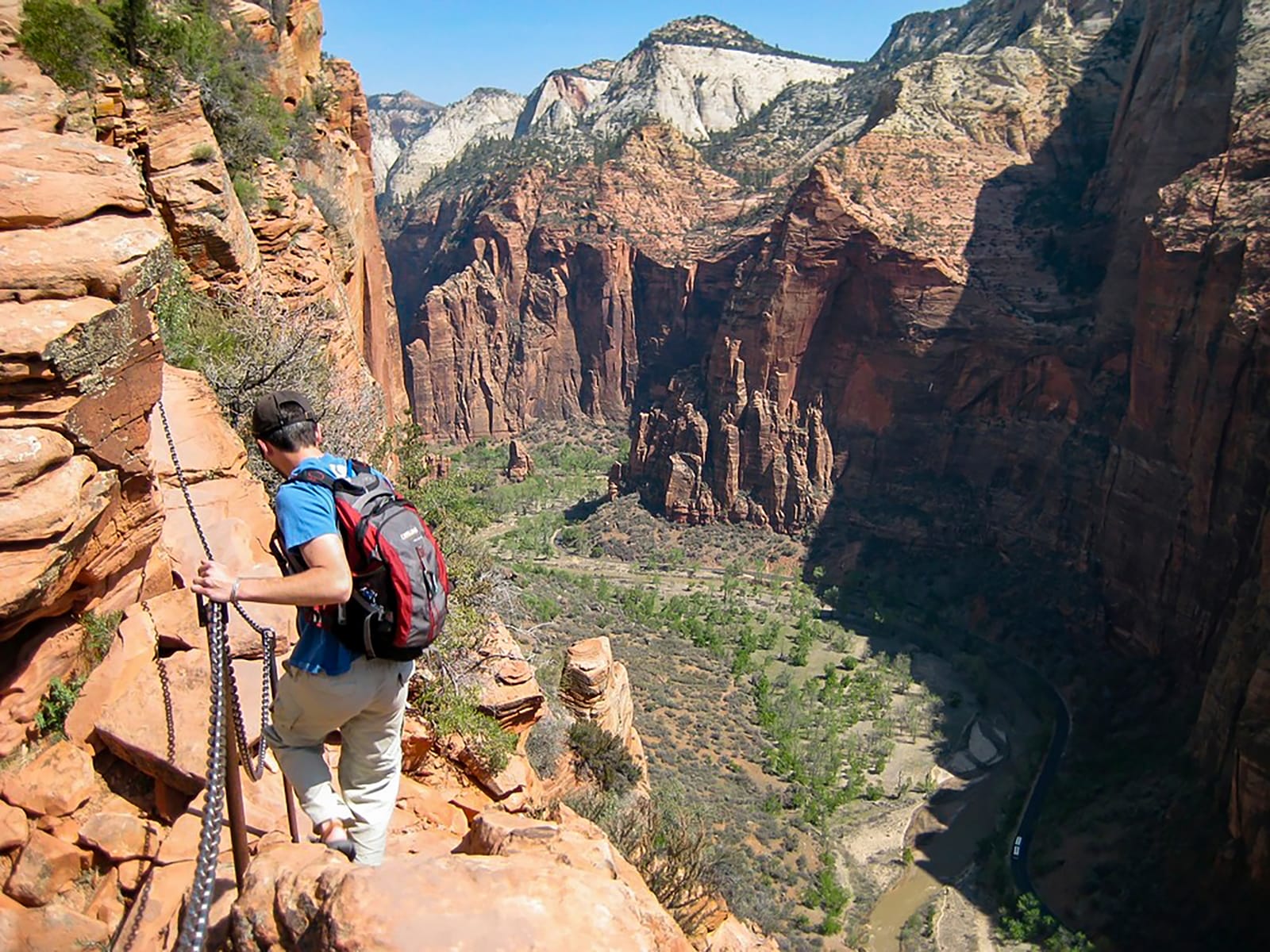
Angels Landing is a fin of Navajo sandstone sticking out into the middle of Zion Canyon, with a trail up the back of it that gets progressively less like a trail. The last half mile is chains bolted into rock, a ridge barely wider than the path, and a thousand feet of air on both sides. From the top you are standing directly above the Virgin River with the canyon opening out in both directions, and it is worth every bit of the fuss.
There are two separate problems to solve: getting a permit, and being honest with yourself about the chains. This page takes both seriously. It works out which lottery you should be entering today, shows you how many permits actually exist on the day you want to go, and tells you plainly where to stop if the exposure is not for you.
Worked out for today
Open right now
Apply on recreation.gov
No seasonal lottery open today
It runs every single day of the year, and it holds about half of every day’s permits plus every seasonal permit somebody handed back. For a trip inside the next few weeks it is not a consolation prize — it is the main way in.
Enter the day-before lotteryOpens next
Hikes 1 December to 28 February
In 14 days Opens October 1, 2026 at 8 am Mountain, closes October 20, 2026. Results October 25, 2026.
One slot, start whenever you like, but only 250 permits a day. Ice on the chains is the reason the park thins it out.
Every day, all year
Runs every day of the year. Cancelled seasonal permits roll into this pool, so it is not the scraps — it is about half of every day’s permits plus whatever was handed back.
Worked out from the recreation.gov lottery calendar, recalculated in your browser each time you open the page (September 17, 2026 if scripts are off). The park publishes the 50% average and the 8–100% range; it does not publish odds for a given date, and neither will we, because the number of applicants per day is not public. Confirm everything on the park’s permit page.
The number the park does not publish
The National Park Service describes the daily quota as “a few hundred to 800 or more”. We pulled a year of recreation.gov availability to find out what it actually is, and the answer changes the week you should be aiming for.
850
a day in high summer
June through August has the most permits of the year, and the worst conditions in which to use them.
27 Sept
the cliff
Permits halve overnight, 825 to 415, as the daylight goes. The single most useful date on the calendar.
250
a day in midwinter
A third of the summer supply — but a small fraction of the demand, too. Cold hands on the chains is the trade.
7 March
the step up
The first week of March still runs on winter numbers. From the 7th it jumps to 820 a day.
Four a year, plus one every day
Each seasonal lottery opens about two months before its season and runs roughly three weeks. Note how the start-time slots change: three windows in spring and autumn, two in summer, one in winter.
Spring
Hikes 1 March to 31 May
Three start windows. The quota steps up to 820 a day on 7 March, so the first week of March is much tighter than the rest of the season.
Summer
Hikes 1 June to 31 August
Only two start windows, and the most permits of the year at 850 a day. "After 9 am" in July means the chains in full sun at a hundred degrees.
Fall
Hikes 1 September to 30 November
The quota halves on 27 September, from 825 a day to 415. Late September is the best combination of weather and availability in the year.
Winter
Hikes 1 December to 28 February
One slot, start whenever you like, but only 250 permits a day. Ice on the chains is the reason the park thins it out.
One application per person, per lottery
You may be on exactly one application. Families and friends stacking separate entries for the same dates get all of them voided, which is a slow way to learn the rule.
Six people to an application
Including you. The $6 application fee covers the whole group; the $3 per person is charged only if you win.
The named holder has to be there
You or the alternate you listed, with photo ID and the permit email. Permits are not transferable and cannot be sold on.
You cannot move your date
No date changes, no adding people, no swapping the permit holder. You can shrink the group, and you can cancel for a refund up to two days out on a seasonal permit.
Cancellations feed the day-before lottery
Every seasonal permit handed back goes into the next day-before draw. It is why the day-before pool is often better than people assume, and why cancelling instead of no-showing matters.
Hiking it without a permit is a federal offence
Up to a $5,000 fine and six months in jail under 36 CFR 1.6. Rangers check on the trail and at Scout Lookout, and there are no day-of permits at any desk in the park.
Where the permit line actually falls
The most common misunderstanding about Angels Landing is that the permit is for the trail. It is not. It is for the last half mile, and everything before it is open to anyone who turns up.
The interactive map needs JavaScript. In short: from the Grotto the West Rim Trail climbs 1.9 miles to Scout Lookout, which needs no permit; the chained half mile from there to the summit does.
Shuttle stop 6. Water, restrooms and the last shade you will see for three hours. Cross the footbridge and turn right.
Paved and level along the Virgin River, which fools people into starting far too fast. Everything after this goes up.
Broad, paved zigzags up the canyon wall with no shade at all. This is where a late start in July becomes a bad decision.
A narrow side canyon that stays twenty degrees cooler than the wall you just climbed, and almost level for a quarter mile. The one genuine rest on the way up.
Twenty-one short switchbacks stacked on top of each other, engineered into the cliff in 1926. Steep, relentless and mercifully brief.
A sandy platform with a composting toilet and a view straight down the canyon. This is where the permit line is, and where a great many people sensibly stop.
From here the trail is a sandstone fin with chains bolted into it and a thousand feet of air on either side. Rangers check permits at this point.
The ridge dips before it rises again — the only part of the chain section that goes downhill, and the spot where two-way traffic backs up worst.
Broader than it looks from below, with room to sit. The last quarter mile climbs at about 1,600 feet per mile, the steepest stretch of the whole hike.
The choice inside the choice
Winning a permit is half the job. The slot you pick decides whether you spend the climb in shade or in full sun, and whether you are on an exposed ridge when the afternoon weather builds.
Before 9 am Take it
Cool rock, the switchbacks still in shade, thinner traffic on the fin, and you are back down before the heat and the weather arrive. If you get a choice, take this one every time.
9 am to 12 pm Fine
Busier on the chains and warm on the climb, but the light on the canyon from the summit is at its best around midday. Fine in spring and autumn, hard work in July.
After 12 pm Think hard
The exposed climb in the hottest part of the day, and you are on the ridge during the monsoon window. It works in November when the days are cool and short; it is unpleasant to dangerous in midsummer.
Any time (winter only) Fine
Winter permits carry no slot. Start late enough for the rock to warm and the ice to go, which in December means not before about ten.
Honest packing
There is not much to it. The list is short, the two things that matter most cost nothing, and a couple of items people bring actively make it worse.
Shoes with genuine grip
The sandstone on the chain section is polished smooth by a million hands and feet. Approach shoes or trail runners with sticky rubber; road trainers with worn soles are how people slip.
Both hands free
You need them for the chains. A small pack that stays on your back, nothing carried, nothing dangling. Phones go in a zipped pocket, not a hand.
Three litres of water a person
There is none after the Grotto and the climb is 1,488 ft with almost no shade. In summer that is a minimum, not a target.
Your permit and photo ID
Screenshot the email before you leave: there is effectively no signal in the canyon. The named holder or the listed alternate has to be the one carrying it.
Gloves
The chains are hot in summer, freezing in winter and greasy year-round. Thin work gloves cost a few dollars and improve the whole experience.
A real breakfast, plus salt
Most of the wobbliness people feel at the notch is low blood sugar and dehydration rather than fear. Eat before the shuttle and carry something salty.
Layers you can stuff away
The Grotto before eight is cold, Scout Lookout in the sun is not, and the summit has wind. Nothing you have to carry in your hands.
Trekking poles
Useful to Scout Lookout, a liability on the chains where you want both hands. If you bring them, collapse and stow them before the fin, and never leave them at the lookout expecting them to be there.
A via ferrata kit or harness
The chains are not rated anchors and the park does not sanction clipping to them. Clipping in gives you confidence the hardware has not earned.
Dogs, drones and small children
Dogs are banned on every Zion trail except the Pa’rus, drones are banned park-wide, and the exposure is not something to talk a nervous child through.
Essential Worth it Leave it
Worth reading before you commit
People die on this hike. We are not going to give you a number, because the published counts disagree with each other and the park keeps no public running tally — but the pattern behind them is well established and worth understanding.
The park states plainly that since 1930 the majority of fatal accidents on this trail have occurred on the chain section. Everything before Scout Lookout is a strenuous walk; everything after it is exposure.
Most accidents on the chains happen in wet conditions. Navajo sandstone that is grippy when dry turns genuinely slick within minutes of rain, and it does not dry quickly in shade.
The park says not to start if there are storm clouds about. A ridge with 1,000-ft drops is the wrong place for an afternoon monsoon cell, and those build fast between July and September.
This is the park’s own advice, not ours. The honest move is to walk to Scout Lookout with your group and let them carry on without you. Nobody at the bottom will think less of you, and it is a far better outcome than freezing at the notch.
The fin is barely wider than the trail in places and you will be passing people coming the other way, sometimes while holding the same chain. Wait at the wide spots and let them come through rather than negotiating a pass on the narrow bit.
Descending the chains is slower and more awkward than climbing them, and it comes when you are tired. Budget as much time for the descent from the summit as for the climb, and do not plan your day around catching a particular shuttle.
The answer for a lot of people
It is 2.25 miles and about 1,000 feet of climbing, it needs no permit and no lottery, and you stand on a platform looking straight down Zion Canyon with the fin of Angels Landing rising in front of you. A good share of the photographs people think are from the summit were taken here.
If you are on the fence about the chains, plan for the lookout and treat the summit as a bonus you decide on when you can see it. That is a far better day than talking yourself onto a ridge you did not want to be on.
From 8,400 feet
46 miles and about 55 minutes to the east entrance, then the tunnel and the drop into the canyon.
Last fuel at Mount Carmel Junction. Eat before you go; there is nothing open early inside the park.
The east entrance drivePrivate cars cannot drive up the canyon in shuttle season. The lot fills early in spring and autumn; Springdale parking and the town shuttle are the backup.
No ticket needed for the canyon shuttle, just the entrance fee. Allow 20 minutes of riding plus whatever the queue costs you.
Half a mile flat along the river, then the switchbacks, Refrigerator Canyon and Walter’s Wiggles. Most people take an hour and a half.
This is the honest moment. If the fin looks like more than you want, stop here — the view is already excellent and the toilet is the last one.
Half a mile out and half a mile back, with passing places. Let people through rather than negotiating the narrow bits, and give the descent as much time as the climb.
Ninety minutes of climbing to 8,400 feet, where the evening runs about twenty degrees cooler than the canyon you just left.
Rooms at the innIf the lottery does not go your way
September 2026
We run an inn ninety minutes up the mountain from Zion’s east entrance and send guests down to this hike all season. The permit rules and the lottery calendar come from the National Park Service and recreation.gov. The daily permit quota is read from recreation.gov’s own availability data across a full year, which is the only way to get a number the park describes only as “a few hundred to 800 or more”. The trail geometry is OpenStreetMap and the elevation profile is USGS 3DEP; our summit measurement of 5,790 ft matches the published figure exactly. We deliberately give no death toll, because published counts disagree and there is no official tally — what we quote instead is the park’s own statement about where the fatal accidents happen. Permit rules change; confirm on the park’s page before you apply.
The ones people actually ask, with the numbers behind them.
For the last half mile, yes — every day, at every hour, all year. You do not need one to hike the West Rim Trail to Scout Lookout, which is 1.9 miles and 1,187 feet of climbing and gets you almost the same view. The permit covers only the chained section beyond the lookout, and hiking it without one is a federal offence carrying a fine of up to $5,000 and up to six months in jail.
The park puts the overall average across both lotteries at about 50%, ranging from 8% in the day-before lottery on Memorial Day weekend to 100% on quiet midweek days. It does not publish odds for a specific date, because that depends on how many people apply, which is not public. What we can show you is the supply side: the number of permits issued each day, which runs from 250 in midwinter to 850 in high summer.
There are four seasonal lotteries a year, each opening about two months before its season and running for roughly three weeks, plus a day-before lottery that runs every single day. If your dates are more than a couple of months out, use the seasonal lottery. If they are not, the day-before lottery is genuinely your main route in — it holds about half of each day’s permits plus every seasonal permit that got cancelled.
The climb to Scout Lookout is 1,187 feet on paved switchbacks — strenuous but ordinary. The chains are a different question entirely, and it is one of nerve rather than fitness. Our measurement puts the last quarter mile at about 1,600 feet per mile, the steepest of the whole hike, and it arrives when your legs are already tired.
The park says no, and so do we. Walk to Scout Lookout with your group, let them go on without you, and enjoy a genuinely excellent view while they queue. Far more people regret starting the chains and freezing partway than regret stopping at the lookout.
Before 9 am, every time you get the choice. Cool rock, the switchbacks still in shade, fewer people on the fin and you are off the ridge before the afternoon weather. In summer there are only two slots, and "after 9 am" means the exposed climb in full sun.
The park says about four hours for the 5.4-mile round trip, and that is realistic if you are fit. Add the shuttle: it is roughly 45 minutes from the visitor center to the Grotto and back, so the outing costs most of a day. Do not plan anything you have to be on time for afterwards.
No. Angels Landing permits exist only through the two online lotteries on recreation.gov. There is no walk-up, no day-of option and no desk in the park that can issue one.
About 46 miles and 55 minutes to the east entrance, then the tunnel, the drive down to the visitor center and the shuttle to stop 6. For a before-9 permit you want to be leaving the inn by about six.
Duck Creek Village Inn is ninety minutes from Zion’s east entrance, and cool enough at night to make an early start easy.