The easy day
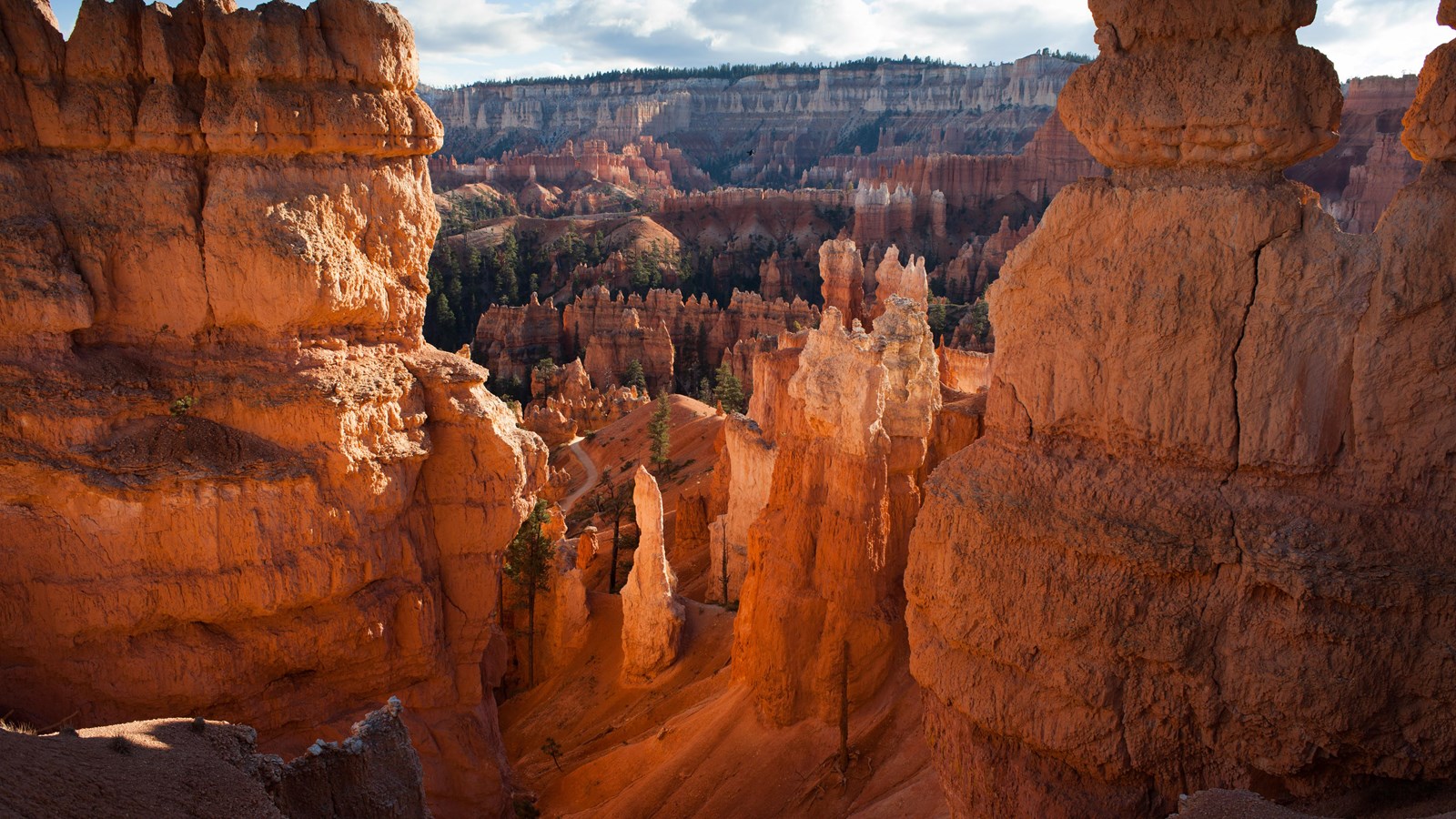
Walk the paved rim between Sunset and Sunrise Points, then drive south to Rainbow Point and loop the Bristlecone. Two easy miles, both ends of the park, and the only hike where the dog can come.
Duck Creek Guide
Twelve trails with the park’s own numbers, on one map, with the climb out drawn to scale
At a glance
Bryce packs an unusually good trail system into a small park. Almost every worthwhile hike starts from one of four viewpoints in the first three miles of the park road, drops below the rim into the hoodoos, and climbs back out with views you cannot get from the top. You can walk one in an hour or spend a whole day down there.
The thing the trail signs cannot tell you is the shape of the walk. Every trail below the rim descends first and climbs at the end, at eight thousand feet, when your legs are already tired. The profiles on this page are sampled from USGS elevation data along each trail, so you can see exactly where the work is before you start. The National Park Service says inappropriate footwear is the single biggest cause of rescues here, and it also says 170-plus nights a year freeze and thaw, which is what keeps the trails rocky and loose.
The whole system hangs off four viewpoints in the first three miles of the park road. Green is easy, amber moderate, rust strenuous. Tap any line for the park’s figures and what the walk is actually like.
The interactive map needs JavaScript. Every trail below the rim starts from Sunrise, Sunset, Inspiration or Bryce Point, all within the first three miles of the park road.
Easy to strenuous
Short, accessible and rewarding. Good for families, for the first hour at altitude, or when you want the view without the commitment.
Trailhead: Sunset Point or Sunrise Point
The easiest walk in the park and the best way to get oriented: a paved half mile along the lip of the amphitheater, with Thor’s Hammer standing below the Sunset Point railing and the whole Silent City spread out to the south. The NPS measures 40 feet of elevation change over the whole thing.
Tip: Walk it in one direction and ride the shuttle back if you would rather not repeat yourself. This is also the section the park names among its best stargazing spots, and it stays open all night.
Trailhead: Rainbow Point or Yovimpa Point
The reward at the end of the scenic drive, looping through spruce and fir at over 9,100 feet past bristlecone pines the NPS dates to 1,800 years old. The views open south toward the Four Corners, and the forest here feels like a different park from the amphitheater.
Tip: Pair it with the drive rather than the hoodoos. It is the natural turnaround at Rainbow Point before you head back north taking the overlooks on your right.
Trailhead: Highway 12, four miles east of the park road
A short walk up Water Canyon to a fork: one way ends at a dripping overhang hung with moss in summer and icicles in winter, the other at a waterfall fed by a pioneer irrigation ditch. The hoodoos overhead are as colourful as anything inside the amphitheater.
Tip: It sits on Highway 12 with no fee booth, so it fits the drive in or the drive home. It is still a fee area: keep your pass or receipt visible in the windshield.
Below the rim and in among the hoodoos. These are the walks that define a Bryce visit, and every one of them ends with a climb.
Trailhead: Any of Bryce, Inspiration, Sunset, Sunrise or Fairyland Points
The trail that connects everything: 5.5 miles along the lip of the amphitheater from Bryce Point north to Fairyland Point, touching every major viewpoint on the way. Most people walk a section rather than the whole thing, and the shuttle makes one-way walks easy from all of them except Fairyland.
Tip: The useful section lengths are Bryce to Inspiration 1.5 miles, Inspiration to Sunset 0.7, Sunset to Sunrise 0.5 and Sunrise to Fairyland 2.8. Only the Sunset to Sunrise half mile is paved and accessible.
Trailhead: Sunrise Point or Sunset Point
The signature Bryce hike. Drop from Sunrise Point through the Queen’s Garden to the Queen Victoria hoodoo, connect to the Navajo Loop, climb the switchbacks between the walls of Wall Street to Sunset Point, then close the loop along the paved rim. It is the whole amphitheater in one walk.
Tip: The NPS recommends hiking it clockwise, descending Queen’s Garden and ascending Navajo, both to spread out traffic and because the steep Navajo switchbacks are safer going up. In winter use the Two Bridges side.
Trailhead: Sunrise Point
The least difficult of the trails that descend into the amphitheater, dropping along a ridgeline from Sunrise Point to a short spur at the Queen Victoria hoodoo. Moderate only because you have to climb back out; the tread itself is well graded the whole way.
Tip: If you only have time for one below-the-rim experience, this is the least demanding way to get among the hoodoos. If you have the legs, continue onto the Navajo Loop and make it the full combination.
Trailhead: Sunset Point
Short, steep and the most dramatic piece of trail in the park. The switchbacks drop from Sunset Point into a corridor where the walls of Wall Street close to a slot with Douglas-firs growing up out of it. Typical grade is 14 percent and the maximum is 30.
Tip: Descend the Wall Street side when it is open and climb out via Two Bridges. In winter Wall Street closes for ice and Two Bridges becomes an out-and-back or a link to Queen’s Garden.
Trailhead: Rim Trail north of Sunrise Point
An out-and-back on the first half of the Fairyland Loop that descends to a shady quarter-mile spur beneath the Tower Bridge formation. It is the quiet alternative to the Queen’s Garden crowds, on the same side of the amphitheater.
Tip: Good if you have already done the combination loop and want something emptier. Park at Sunrise Point; the trailhead is a few minutes north along the Rim Trail.
Trailhead: Swamp Canyon Viewpoint, park mile 6
The one real hike on the southern half of the drive, dropping off the rim into a green pocket where two creeks and a spring keep four habitats packed together. More rugged and far quieter than anything in the amphitheater, and it links to the Under-the-Rim Trail.
Tip: The NPS notes there is less signage here and asks hikers to carry a map. Oversized vehicles can park at the viewpoint, which is not true of the amphitheater lots during shuttle hours.
Big days that go deeper than most visitors ever see. Start early, carry more water than you think you need, and respect the altitude.
Trailhead: Bryce Point
The best extended below-rim hike in the park, dropping deeper than the Queen’s Garden or Navajo trails into hoodoo corridors, windows and narrow passages most visitors never see. The loop is shared with the concession horse rides, so expect traffic and give way to stock.
Tip: The NPS recommends hiking it clockwise. Start early: this is real elevation at real altitude, the pit toilets on the west side are summer-only, and there is no water or shade below the rim.
Trailhead: Bryce Point
An out-and-back on the first stretch of the Under-the-Rim Trail, descending 1,380 feet through ponderosa forest to narrow orange pinnacles capped with grey boulders that look like hats. Different hoodoos from the amphitheater, and far fewer people.
Tip: Everything you descend you climb back, at the end, at 8,000 feet. Start early and save energy for the return. Bryce Point parking is easiest in the morning.
Trailhead: Fairyland Point, or Tower Bridge trailhead north of Sunrise Point
A full day circling the northern end of the amphitheater, past Tower Bridge and the fin the park calls the Chinese Wall, through formations most visitors never reach. The return leg runs along the rim near Boat Mesa with the whole bowl on your right.
Tip: Fairyland Point sits before the fee booth and has no shuttle stop, so you have to walk back to wherever you parked. The NPS recommends the counter-clockwise direction.
Trailhead: Yovimpa Point
The big one at the end of the road, dropping off Yovimpa Point through heavy forest with long views to the distant cliffs. No permit is needed to walk it in a day; an overnight in the backcountry campsites does require one.
Tip: Usually hiked counter-clockwise, and often as an overnight. Accessible restrooms at Yovimpa Point, no water on the loop, and oversized vehicles can park at the trailhead.
A full day at Bryce usually holds two hikes, but the altitude stretches everything. The reliable formula is one rim-level walk plus one below-the-rim trail, with the descent done early while the amphitheater is still in good light.
Walk the paved rim between Sunset and Sunrise Points, then drive south to Rainbow Point and loop the Bristlecone. Two easy miles, both ends of the park, and the only hike where the dog can come.
The Queen’s Garden and Navajo Loop combination in the morning, clockwise as the park recommends, then the Rim Trail south to Inspiration Point and Bryce Point in the afternoon. This is the Bryce greatest-hits day and the one most guests take.
Peekaboo Loop as the single anchor, from Bryce Point, clockwise. Connect it to the Queen’s Garden combination for a figure eight if you are strong, but skip the second hike and drive the scenic road instead if you are not.
One Bryce hiking day pairs well with a slower day near the village. After the hoodoos, recover with a morning at Aspen Mirror Lake, a drive to Cedar Breaks, or a village dinner and a quiet evening on the deck.
The altitude is the reason to stay up here rather than down in the valley: the inn sits at 8,455 feet, within a few hundred feet of every trailhead in the park, so you sleep at hiking altitude instead of driving up to it. Compare our rooms and cabins, or read the full Bryce day-trip guide for the drive and the viewpoints.
September 2026
Every distance, elevation gain, time and difficulty rating on this page is the figure the National Park Service publishes for that trail, so the numbers here match the numbers on the trailhead sign. The map is OpenStreetMap geometry and the elevation profiles are USGS 3DEP. We write the rest as innkeepers who send guests up Scenic Byway 12 all year. Trails close for ice and rockfall, so check conditions the morning you go.
Common questions from trip planners.
The paved half mile of Rim Trail between Sunset and Sunrise Points, 1 mile round trip with 40 feet of elevation change. It is wheelchair accessible, it is the only Bryce trail open to leashed dogs, and it delivers the classic amphitheater view with almost no effort. For a little more, Mossy Cave is 0.8 miles and 150 feet on Highway 12, outside the fee booth.
The Queen’s Garden and Navajo Loop combination: 2.9 miles, 625 feet of climbing, 2 to 3 hours, rated moderate. The National Park Service recommends it to first-time visitors, and it shows you the amphitheater from below the rim and along it in a single loop.
Most day-trippers from Duck Creek manage one below-the-rim hike plus some rim walking. If you are fit, start early and keep lunch short, the Peekaboo Loop plus the paved rim makes a full day. Two below-the-rim hikes in one day is more climbing at altitude than it sounds like.
Only on pavement. Leashed dogs are allowed on the paved Rim Trail section between Sunset and Sunrise Points, in parking lots and campgrounds, at paved viewpoints and on the shared-use path. No unpaved trail in the park is open to dogs, and they are not allowed on the shuttle or at Piracy Point.
It is the thing visitors underestimate most. Trailheads sit between 8,000 and 9,115 feet, and every below-the-rim hike saves its climb for the end. Guests staying at Duck Creek Village have an advantage here: the inn is at 8,455 feet, so you sleep at trailhead altitude and arrive already adjusted.
The Wall Street side of the Navajo Loop closes for the season, and the 1.5-mile Rim Trail section between Bryce Point and Inspiration Point is regularly closed. Long loops like Fairyland, Riggs Spring and Swamp Canyon can be impassable under snow the park measures at 2 to 15 feet. The rest stays open with traction devices.
A free park program: find the benchmark medallions along the marked trails, walk at least 3 miles, show your photos or rubbings at the visitor center and collect a reward. There are 9 benchmarks spread over 8 trails, and the Queen’s Garden and Navajo combination alone picks up two of them.
Book your room or cabin at Duck Creek Village Inn: 68 minutes from the trailheads, at the same altitude, so you arrive already acclimated.