预订 预订住宿
直接预订立减 10%,代码 立减 10% · 12月1日 前入住 · 适用于 2026年12月1日 前入住
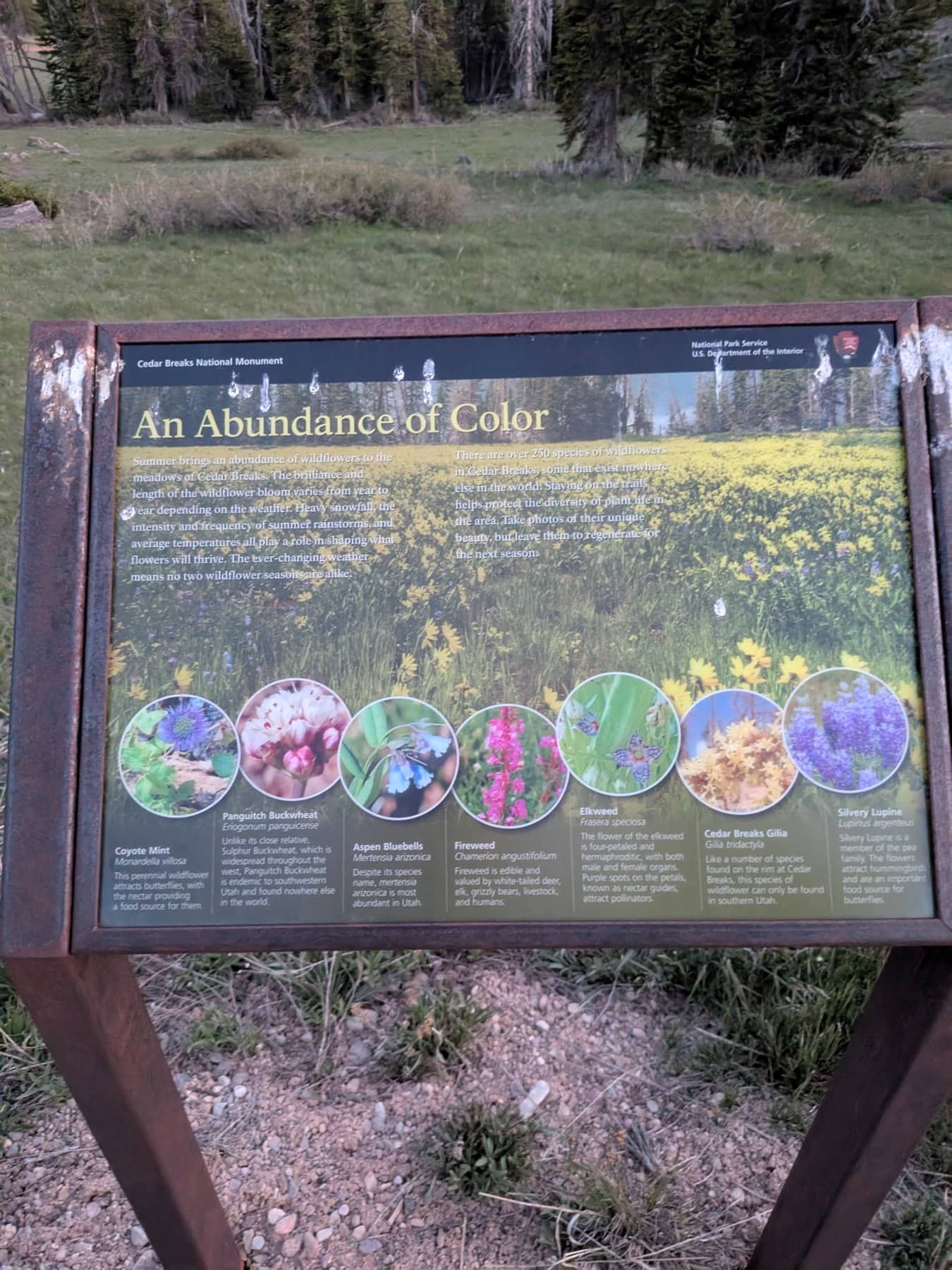
The National Park Service wildflower sign at Cedar Breaks, An Abundance of Color, standing in a subalpine meadow at dusk

Duck Creek 指南

Cedar Breaks Wildflowers

Over 250 species at 10,000 feet, two of them found nowhere else. When they bloom, where to walk, and how to tell them apart.

For about six weeks every summer the meadows along the Cedar Breaks rim do something the red rock below them cannot: they change every day. Snow that piled twenty feet deep in April melts into ground that, by the first week of July, is blue with lupine and flax, spotted red with paintbrush, and studded with head-high elkweed stalks. The park counts over 250 species of wildflowers in its 6,155 acres, some of them growing nowhere else on Earth, and it throws a festival for them.

This page is the wildflower guide we wanted when we first drove up from the inn: a week-by-week bloom calendar, an illustrated field guide to the twenty flowers you are most likely to meet, the two endemics and where to find them, the four best walks, and the 2026 festival schedule. Cedar Breaks is 25 minutes from our rooms, so a wildflower morning fits before lunch, and a second visit for sunset uses the same seven-day pass.
Wildflowers at a glance

Species
Over 250 wildflowers among 269 plant species recorded in the monument
Peak bloom
Early to mid July most years; late June starts it, August finishes it
Endemics
Two flowers found only in this corner of Utah: Cedar Breaks gilia and Panguitch buckwheat
Festival
July 3 to 11, 2026. Ranger walks daily at 10:30 a.m., free with entry
Best walk
Alpine Pond loop, 2 miles from Chessmen Ridge, for the meadows; the rim trail for the endemics
Elevation
10,000 to 10,500 ft. Bring a jacket, water and sunscreen even for a short walk
From the inn
About 16 miles and 25 minutes, west on Highway 14 and north on 148
Rules
Stay on the trail and leave every flower to seed. Picking is prohibited in the monument

Bloom calendar, late May to September

The season runs about sixteen weeks from the first flowers to the last, and the park's own sign puts the caveat well: heavy snowfall, the intensity and frequency of summer rainstorms, and average temperatures all decide which flowers thrive, and no two seasons are alike. A big snow year pushes everything a week or two later; a dry spring pulls it forward. Read the bars as the usual window and the 2026 festival shading as the park's best guess at peak.

Approximate bloom weeks for Cedar Breaks wildflowers, late May to mid September
Flower Weeks from late May to mid September
Springbeauty
Late May to Mid June. The first week or two after snowmelt.
Marsh marigold
Late May to Late June. Right behind the melting snow, late May into June.
Cushion phlox
June to July. June.
Silvery lupine
June to Mid Aug. Late June through July.
Blue flax
Mid June to Late July. Late June and early July.
Pretty shooting star
Mid June to Late July. Late June into July.
Aspen bluebells
Mid June to Sept. Late June through August.
Parry primrose
Late June to August. Early to mid July.
Scarlet paintbrush
Late June to Mid Sept. Mid July, but there is some all summer.
Larkspur
July to Mid Aug. Midsummer, July.
Elkweed
July to Mid Aug. July.
Colorado columbine
July to Late Aug. Mid July to early August.
Markagunt penstemon
July to Late Aug. July.
Cedar Breaks gilia endemic
Mid July to Sept. Mid July to August.
Panguitch buckwheat endemic
Mid July to Sept. Mid July to August.
Mountain coyote mint
Mid July to Sept. Late July.
Fireweed
Mid July to Mid Sept. Late July and August.
Shrubby cinquefoil
Mid July to Mid Sept. Midsummer.
Little sunflower
August to Mid Sept. August.
Aster
Late Aug to Mid Sept. Late August into September.
  • Wildflower Festival, 2026
  • This week
  • Usual bloom window; peaks vary a week or two with the snowpack

Late May to Mid June

Snowmelt, late May to mid June

The road opens and the first flowers follow the receding snow: marsh marigold in the wet spots, springbeauty in the meadows, cushion phlox on the rim. Trails are muddy and some north-facing sections still hold snow.

Late June to July

Early bloom, late June

Lupine, aspen bluebells and blue flax turn the meadows blue. Paintbrush starts. Chessmen meadow is at its best about now.

Mid July to August

Peak, early July to late July

Everything at once: columbine, paintbrush, lupine, larkspur, elkweed stalks head-high, the endemic gilia and buckwheat on the rim. The Wildflower Festival runs in the first half of July for this reason.

Mid Aug to Late Aug

Late season, August

The meadows go gold with little sunflower and showy goldeneye, fireweed lines the road, and the bluebells keep going. Afternoon storms are at their most reliable.

Sept to Mid Sept

Last flowers, September

Aster and the last of the sunflowers, then frost. The aspen below the rim begin to turn in the last ten days of the month.

Field guide: twenty flowers to know

Names and spellings follow the park's own species pages. The drawings are ours, simplified on purpose: enough to tell a shooting star from a paintbrush at trail speed, not a botanical plate. Flowers marked endemic grow only in this part of Utah.

  1. Marsh marigold

    Caltha leptosepala · White

    Right behind the melting snow, late May into June

    The first big white flower of the season. It often blooms with snow still on the ground a few feet away.

    The boggy ground around Alpine Pond and the seeps below Chessmen Ridge as soon as the trail is clear of snow.

  2. Springbeauty

    Claytonia lanceolata · Pink

    The first week or two after snowmelt

    Tiny and pink, and one of the first flowers to open. Easy to walk past unless you look down.

    Anywhere the snow has just left, especially the campground meadow.

  3. Cushion phlox

    Phlox pulvinata · White

    June

    A low mat of white to pale lavender flowers that hugs the rock where nothing else grows yet. One of the late June early bloomers.

    The exposed ground along the Spectra Point trail and the rim edge at Point Supreme.

  4. Silvery lupine

    Lupinus argenteus · Blue

    Late June through July

    A member of the pea family. The flowers attract hummingbirds and are an important food source for butterflies, according to the park sign.

    Every meadow on the Alpine Pond loop, and the roadside between Point Supreme and Chessmen Ridge.

  5. Aspen bluebells

    Mertensia arizonica · Blue

    Late June through August

    Despite the species name, Mertensia arizonica is most abundant in Utah. Drooping clusters of blue bells that bloom for most of the summer.

    Just about everywhere. The park calls it one of its most common flowers.

  6. Blue flax

    Linum lewisii · Blue

    Late June and early July

    Five papery blue petals that drop by afternoon; each plant opens new ones the next morning. Come before noon.

    Chessmen meadow, which the park brochure says turns bright blue with it in early summer.

  7. Scarlet paintbrush

    Castilleja miniata · Red

    Mid July, but there is some all summer

    The red is not the flower but the bracts around it. Paintbrush is a partial parasite that taps the roots of neighboring plants, which is why you cannot transplant it.

    The meadows on the Alpine Pond loop and along the rim trail south of the visitor center.

  8. Colorado columbine

    Aquilegia caerulea · White

    Mid July to early August

    Usually blue and white elsewhere in the Rockies. At Cedar Breaks the flowers tend toward pale lavender and white, which the park attributes to the local population.

    The shaded forest sections of the Alpine Pond loop and the ground below the bristlecones on Spectra Point.

  9. Larkspur

    Delphinium sp. · Purple

    Midsummer, July

    Deep purple, with the spur on the back of each flower that gives it its name. Toxic to cattle, which is why old ranchers on the plateau hated it.

    The wet meadow below Alpine Pond and the drainage on the campground trail.

  10. Pretty shooting star

    Dodecatheon pulchellum · Pink

    Late June into July

    Pink petals swept straight back from a dark point, like a badminton shuttlecock. Bees "buzz pollinate" it by vibrating the flower until it releases pollen.

    The marshy edge of Alpine Pond.

  11. Elkweed

    Frasera speciosa · Green

    July

    The most dramatic plant in the park. It grows a rosette of leaves for years, then sends up a single stalk of four-petaled greenish flowers with purple spots that guide pollinators to the nectar, and dies after it seeds. The park sign notes each flower has both male and female parts.

    Standing head-high above the grass in the meadows near Point Supreme and along the Alpine Pond loop.

  12. Cedar Breaks gilia Endemic

    Ipomopsis tridactyla · White

    Mid July to August

    Found only in southern Utah, and the park says only at Cedar Breaks. A small, sprawling plant with three-lobed leaves and white trumpet flowers, easy to miss and one of the reasons the park asks you to stay on the trail.

    The rim edge itself, in the gravel between Point Supreme and Spectra Point. Look down, not out.

  13. Panguitch buckwheat Endemic

    Eriogonum panguicense · Pink

    Mid July to August

    Endemic to southwestern Utah and found nowhere else in the world, per the park sign, unlike its widespread cousin sulphur buckwheat. Pink and cream flower heads on a tight cushion of leaves.

    Cushions on the pale rim gravel near Spectra Point, often right beside the gilia.

  14. Mountain coyote mint

    Monardella odoratissima · Purple

    Late July

    Crush a leaf and it smells like mint. The park sign credits it with attracting butterflies, which use the nectar as a food source.

    Sunny ground along the South Rim Trail toward Spectra Point.

  15. Fireweed

    Chamerion angustifolium · Pink

    Late July and August

    Magenta spires that open from the bottom up, so you can read the season off one plant. Edible, and per the park sign valued by deer, elk, grizzly bears (elsewhere), livestock, and people.

    Road edges on Highway 148 and the cleared ground around the campground.

  16. Shrubby cinquefoil

    Potentilla fruticosa · Yellow

    Midsummer

    Named for its five-part leaves. A knee-high shrub covered in yellow five-petaled flowers, the same plant sold as a garden shrub in town.

    The campground meadow and around Alpine Pond.

  17. Markagunt penstemon

    Penstemon leiophyllus · Purple

    July

    Named for the plateau you are standing on. Tubular blue to purple flowers with five lobes, built for bees, which is why you will see them crawling inside.

    Along the rim trail and the roadside meadows.

  18. Parry primrose

    Primula parryi · Pink

    Early to mid July

    Big magenta flowers with a yellow eye on a stalk that can reach a foot. It smells faintly of skunk up close; admire it from standing height.

    The seep below the Alpine Pond outlet.

  19. Little sunflower

    Helianthella uniflora · Yellow

    August

    The late show. When the lupine and columbine are done, the sunflowers and showy goldeneye take over the meadows for the rest of summer.

    The big meadows near Point Supreme and along the road, which the brochure says it turns gold in August.

  20. Aster

    Symphyotrichum sp. · Purple

    Late August into September

    One of the last flowers still blooming in September, pale purple with a yellow center. The season ends with aster and the first gold in the aspen.

    Roadsides and meadow edges after the first frosts.

Two flowers that grow nowhere else

Most of what blooms at Cedar Breaks also blooms on other high plateaus in the West. Two plants do not. Cedar Breaks gilia is, according to the park, found only here, a sprawling little plant with three-lobed leaves and white trumpet flowers that lives in the bare limestone gravel right at the rim. Panguitch buckwheat is endemic to southwestern Utah, a cushion of gray-green leaves with pink and cream flower heads, and it shares the same few yards of ground. The Northern Colorado Plateau inventory lists seven rare plants in the monument in all, including Reveal's paintbrush and Cedar Breaks goldenbush, and the endangered Arizona willow in the wet ground below the rim.

Both endemics flower from mid July into August, and both are small enough to step on. That is the practical reason the park is strict about staying on the South Rim Trail: the gilia grows an inch from the tread, and a shortcut to a viewpoint can take out a plant that exists in no other place. Bring a macro lens, kneel at the edge of the trail, and look down.

The park's trailside wildflower sign photographed at dusk, with seven species pictured in circles: coyote mint, Panguitch buckwheat, aspen bluebells, fireweed, elkweed, Cedar Breaks gilia and silvery lupine
The park's sign, An Abundance of Color, on a June evening. Its seven featured species, coyote mint, Panguitch buckwheat, aspen bluebells, fireweed, elkweed, Cedar Breaks gilia and silvery lupine, are all in the field guide above. Our photo, 1 June 2026.

Where to see them: four walks

All four start from a paved lot on Highway 148 and none takes more than a couple of hours. In festival week the ranger walks pick whichever meadow is peaking; outside it, this is the order we would do them.

Alpine Pond loop

2 miles · Chessmen Ridge trailhead

The meadow walk. Lupine, bluebells, paintbrush and columbine line the trail, elkweed stands above the grass, and the marshy pond edge has shooting star and marsh marigold. Do the loop clockwise so you reach the meadows with the sun behind you. There is a one-mile short loop if the altitude is talking.

Trail details

South Rim Trail to Spectra Point

2 miles round trip · Point Supreme

The endemics live here, in the gravel at the rim edge, along with cushion phlox early in the season and columbine under the bristlecone pines. Look down as much as out. This is the trail the park most wants you to stay on, because the gilia grows an inch from the tread.

Trail details

Campground Trail

Half a mile · flat and accessible

A paved, level path through the campground meadow across the road from Point Supreme. The easiest wildflower walk in the monument, with cinquefoil, bluebells and, in August, the sunflowers. Fine for strollers and anyone who does not want to breathe hard at 10,000 feet.

Trail details

The roadside meadows

Highway 148 pullouts

Between Point Supreme and Chessmen Ridge the road crosses open meadows that turn blue with flax and lupine in late June and gold with sunflowers in August. Use the paved pullouts and stay on the shoulder; the meadows are fragile and the rangers do write tickets for driving onto them.

Trail details
  • The drive from the inn
  • Highway 148 through the monument
  • Overlook
  • Trail point
  • Visitor center
  • Campground

Trail points and overlooks along Highway 148. Tap a pin for the note and the page that covers it. The green dashed line is the road through the monument; the drive from the inn is on the main Cedar Breaks guide.

The Wildflower Festival, July 3 to 11, 2026

The park has run a Wildflower Festival every July for years, timed to the peak. The 2026 edition runs July 3 to 11. Ranger-led wildflower walks leave at 10:30 a.m. daily, with a second walk at 2 p.m. on Saturdays; they are under a mile, free, and you sign up in person at the visitor center the same day. A ranger gives a short talk at 1:30 p.m. daily at Point Supreme Overlook on how these plants survive a ten-week growing season. Booths at the visitor center plaza run Fridays and Saturdays, kids can do a wildflower scavenger-hunt bingo for a sticker, and the Blooms of the Breaks art contest takes entries all month by email.

Everything is included in the $25 vehicle entry, which is also good for seven days, so a festival walk on Saturday morning and a Night Sky Tour on Saturday evening cost the same as one visit. The festival dates move each year with the snowpack; the park announces them in spring on its festival page, and we update this page when they do.

Daily during the festival

  • 10:30 a.m.Ranger-led wildflower walk, under a mile. Register at the visitor center. Extra walk at 2 p.m. on Saturdays.
  • 1:30 p.m.Ranger talk at Point Supreme Overlook on how the meadows work.
  • Fri and SatInteractive booths at the visitor center plaza; scavenger-hunt bingo for kids.
  • All JulyBlooms of the Breaks art contest, youth and adult divisions, entries to cebrinfo@nps.gov.

Visitor center open 9 a.m. to 5 p.m. daily. Entry $25 per vehicle, cards only.

Why 10,000 feet blooms all at once

The rim at Cedar Breaks gets about 30 inches of precipitation a year, most of it as snow, and the park says snowfall can exceed 30 feet. The road closes in November and the visitor center reopens in late May. Between the last drift and the first hard frost the meadows have roughly ten to twelve weeks to leaf out, flower, get pollinated and set seed, so everything that can bloom does it in the same few weeks. That is why July at Cedar Breaks looks like a garden planted on purpose, and why a late-melting year compresses the whole show into an even shorter window.

The plants have their own tricks. Elkweed spends years as a low rosette storing energy, then flowers once on a stalk taller than you and dies. Paintbrush taps the roots of its neighbors for water. Blue flax opens a fresh set of petals every morning because the afternoon wind shreds the old ones. And the pollinators, which the park's sign says the flowers cannot reproduce without, work the meadows only while it is warm, which at this elevation means late morning to mid afternoon. Plan your walk for the same hours.

Photographing the meadows

  • Go in the morning for the blue. Blue flax drops its petals by early afternoon and opens fresh ones the next day, so the Chessmen meadow is at its bluest before noon.
  • Overcast is your friend. High-altitude sun at midday flattens colors and blows out the whites. The best wildflower light is a thin cloud layer or the hour after a passing storm.
  • Get low and stay on the trail. Almost every good meadow shot is taken kneeling at the edge of the tread. You never need to step into the flowers, and the rangers will ask you not to.
  • Bring a macro lens or your phone in macro mode for the endemics. Cedar Breaks gilia flowers are the size of a fingernail.
  • Watch the sky after 1 p.m. July and August thunderstorms build over the plateau most afternoons. The rim is the most exposed ground in the monument.
  • Take the 10:30 walk during the festival. A ranger will find you more species in an hour than you will find in a day, and they know which meadow is peaking that week.

Making a day of it from Duck Creek

  • Morning flowers, evening stars. Walk Alpine Pond at ten, lunch at the inn, then back up for sunset at Sunset View and a Night Sky Tour. One entry fee, two visits, and you are in a warm bed 25 minutes after the telescopes pack up.
  • Add the lake. Navajo Lake is on the way, ten minutes below the junction. The Cedar Breaks and Navajo Lake itinerary puts the two together.
  • Two elevations, two seasons. The village sits 2,000 feet lower than the rim, so the meadows around Duck Creek Pond and along the local trails bloom in June, before Cedar Breaks starts. A late June stay catches both.
  • Come back in September. When the asters finish, the aspen take over. Our fall colors tracker follows the turn week by week, and the Cedar Breaks road usually stays open until mid October.
  • Check the road first. Highway 148 opened on May 15 in 2026; some years it is June. Conditions today has the live status.

Reviewed September 2026

为什么信任这份指南

We are 25 minutes down the mountain and walk these meadows every summer. Species names and the festival schedule come from the National Park Service's Cedar Breaks pages and its Common Wildflowers brochure; the endemic and pollinator notes are from the park's own trailside sign, which we photographed; the bloom windows combine the brochure's timing with the Iron County visitor bureau's notes and the festival dates. Bloom timing shifts with the snowpack, so treat the calendar as a guide and the visitor center as the authority for any given week.

Cedar Breaks wildflower questions

Peak dates, the festival, the endemics, rules, and what to wear.

When is the best time to see wildflowers at Cedar Breaks?

Early to mid July in a typical year. The first flowers follow the melting snow in late May, the meadows turn blue with lupine, flax and bluebells in late June, everything peaks in the first half of July, and sunflowers carry August. The park schedules its Wildflower Festival for the peak; in 2026 that is July 3 to 11.

When is the Cedar Breaks Wildflower Festival?

July 3 to 11, 2026. Ranger-led wildflower walks leave at 10:30 a.m. daily and 2 p.m. on Saturdays, there is a ranger talk at 1:30 p.m. daily at Point Supreme Overlook, and booths run at the visitor center plaza on Fridays and Saturdays. Everything is free with the $25 vehicle entry. The dates move a week or so each year with the snowpack.

How many wildflower species are at Cedar Breaks?

The park's trailside sign says over 250 species of wildflowers; the National Park Service plant inventory lists 269 vascular plant species in the monument, including trees and grasses. Some exist nowhere else in the world.

Which Cedar Breaks wildflowers are found nowhere else?

Two are named on the park sign: Cedar Breaks gilia (Ipomopsis tridactyla), which the park says grows only here, and Panguitch buckwheat (Eriogonum panguicense), endemic to southwestern Utah. Both are small plants of the bare rim gravel near Point Supreme and Spectra Point. Reveal's paintbrush and Cedar Breaks goldenbush are two more rare plants the park monitors.

What is the best trail for wildflowers at Cedar Breaks?

The Alpine Pond loop from Chessmen Ridge Overlook, two miles through meadows and forest to a subalpine pond. For the endemic species walk the South Rim Trail from Point Supreme toward Spectra Point and watch the gravel at the rim edge. The half-mile Campground Trail is the flat, accessible option.

Can you pick wildflowers at Cedar Breaks?

No. Picking flowers or removing anything from a national monument is prohibited, and the park asks visitors to stay on trails so this year's flowers can seed next year's. The endemics grow right at the edge of the tread.

Are dogs allowed on the wildflower trails?

No. Pets are allowed only on paved areas and in parking lots at Cedar Breaks, plus the paved Sunset Trail between Point Supreme and Sunset View. The Alpine Pond and rim trails are off limits to dogs.

What should I wear for a July wildflower walk at 10,000 feet?

Layers. Summer highs at the rim are 60 to 70°F and the wind is steady; mornings can be in the 40s. Sturdy shoes for muddy trail sections, a hat and sunscreen because the sun is strong through thin air, water, and a rain shell for the afternoon storms.

Is Cedar Breaks still worth visiting for flowers in August?

Yes. The meadows go gold with little sunflower and showy goldeneye, fireweed lines the road, and the bluebells keep going. The columbine and lupine are mostly done by mid August. By mid September only asters are left, and the aspen below the rim start to turn.

Where do wildflowers bloom earlier than Cedar Breaks?

Lower. Duck Creek Village sits at 8,400 feet, so the meadows around the village and Duck Creek Pond bloom two to three weeks ahead of the rim, in June. Staying at the inn lets you catch both in one trip.

Stay 25 minutes from the meadows

Rooms with breakfast or cabins with a kitchen at Duck Creek Village Inn. Walk the wildflowers in the morning, watch the stars at night, sleep at 8,400 feet in between.

直订立减 10%,代码 · 适用于 2026年12月1日 前入住 直订最优价 · 现在预订,之后付款

致电我们 · 435-990-5488