January in Duck Creek Village averages 40F afternoons and 9 to 17F nights, the coldest month of the year at every station near the village. Station data on snow depth, the dry years and the storm years, Martin Luther King Jr. Day snow, Cedar Breaks and the valley towns below.
What Is the Weather Like in Duck Creek Village in January?
January in Duck Creek Village averages about 40F in the afternoon and 9 to 17F at night, measured at stations near village elevation. Almost every night freezes. It is the coldest month of the year on average, snow covers the ground in most years, and the amount of new snow swings from none at all to a month of storms.
The days run short, too: 9 hours 41 minutes of daylight on New Year’s Day.
| January in Duck Creek Village | Number |
|---|---|
| Average daytime high | About 40F, 33F at the summit |
| Average overnight low | 16 to 17F on slopes, 9F in meadows |
| Nights at or below freezing | 30 to 31 of 31 |
| Precipitation | 1.6 to 2.3 in, 4.3 in at the summit |
| Daylight | 9 h 41 m on Jan 1, 10 h 21 m on Jan 31 |
Four stations near the village set the January numbers
A rain gauge stood at the Duck Creek ranger station from 1934 to 1936, and the village has had no working station since. The numbers here come from four neighbors. The Assay fire weather station sits at 8,100 feet, six miles east. Panguitch Lake reports from 8,300 feet, Harris Flat from a meadow at 7,800 feet, and Midway Valley from 9,830 feet near the Highway 14 summit.
The afternoons agree. Assay averages 39.6F, Harris Flat 39.8F and Panguitch Lake 40.0F, all within half a degree. Midway Valley runs seven degrees colder at 33.2F, with about 13 January afternoons that never reach freezing.
The nights split by ground, the pattern our December weather post traced. Assay averages a 17.4F low and Panguitch Lake 15.6F. Harris Flat averages 8.7F, because cold air slides off the slopes after dark and pools in the flat meadow. That meadow falls to zero or below on six or seven January nights a year, against about one on the slopes.
Sunset moves from 5:25 pm on January 1 to 5:55 pm on January 31, and sunrise holds between 7:33 and 7:44 am.
January is the coldest month, and February holds the coldest night
Average every January day since the stations came online, and January comes out colder than December, February or any other month. It has the lowest average high at all four stations and the lowest average low at three of them. Midway Valley’s February low runs a tenth of a degree colder, a tie in practice.
| January cold | Record |
|---|---|
| Coldest ten days near the village | Jan 21 to 31, lows 7.8F at Harris Flat |
| Nights at zero or below | About 7 at Harris Flat, 1 on slopes |
| Coldest January night on record | Minus 19.5F at Harris Flat, Jan 25, 2017 |
| Warmest January day on record | 61F at Assay, Jan 22, 2013 |
The last ten days of January form the coldest stretch of the whole winter near village height. Harris Flat lows average 7.8F from January 21 to 31, below any other ten-day window from December through March, and Panguitch Lake shows the same thing at 14.1F.
The single coldest night of the winter, though, lands in February more often. January held it in 4 of 12 winters at Harris Flat and 3 of 12 at Panguitch Lake, while February held it in 5 of 12 at both. Our February weather post covers that pattern. January’s record is minus 19.5F at Harris Flat on January 25, 2017, a night that also hit minus 13.4F at Midway Valley. A cold snap from January 12 to 15, 2013 took Midway Valley to minus 19.3F and Assay to minus 15F.
January snow swings from bare ground to a month of storms
| January snow | Number |
|---|---|
| Snow depth on Jan 1, median | 8 to 9 in near village height, 31 in at the summit |
| Snow depth on Jan 31, median | 14.5 in, 43 in at the summit |
| Days with 2 in or more overnight | 2 to 3, about 5 at the summit |
| Snow on Martin Luther King Jr. Day | 14 of 16 years at Harris Flat |
January brings 2.3 inches of water at Harris Flat, its third wettest month, and 4.3 inches at Midway Valley, second to March. Averages hide the real story here. January 2022 delivered 0.0 inches at Harris Flat and Panguitch Lake and 0.1 at the summit. A year later, January 2023 brought 5.8, 3.7 and 10.6 inches.
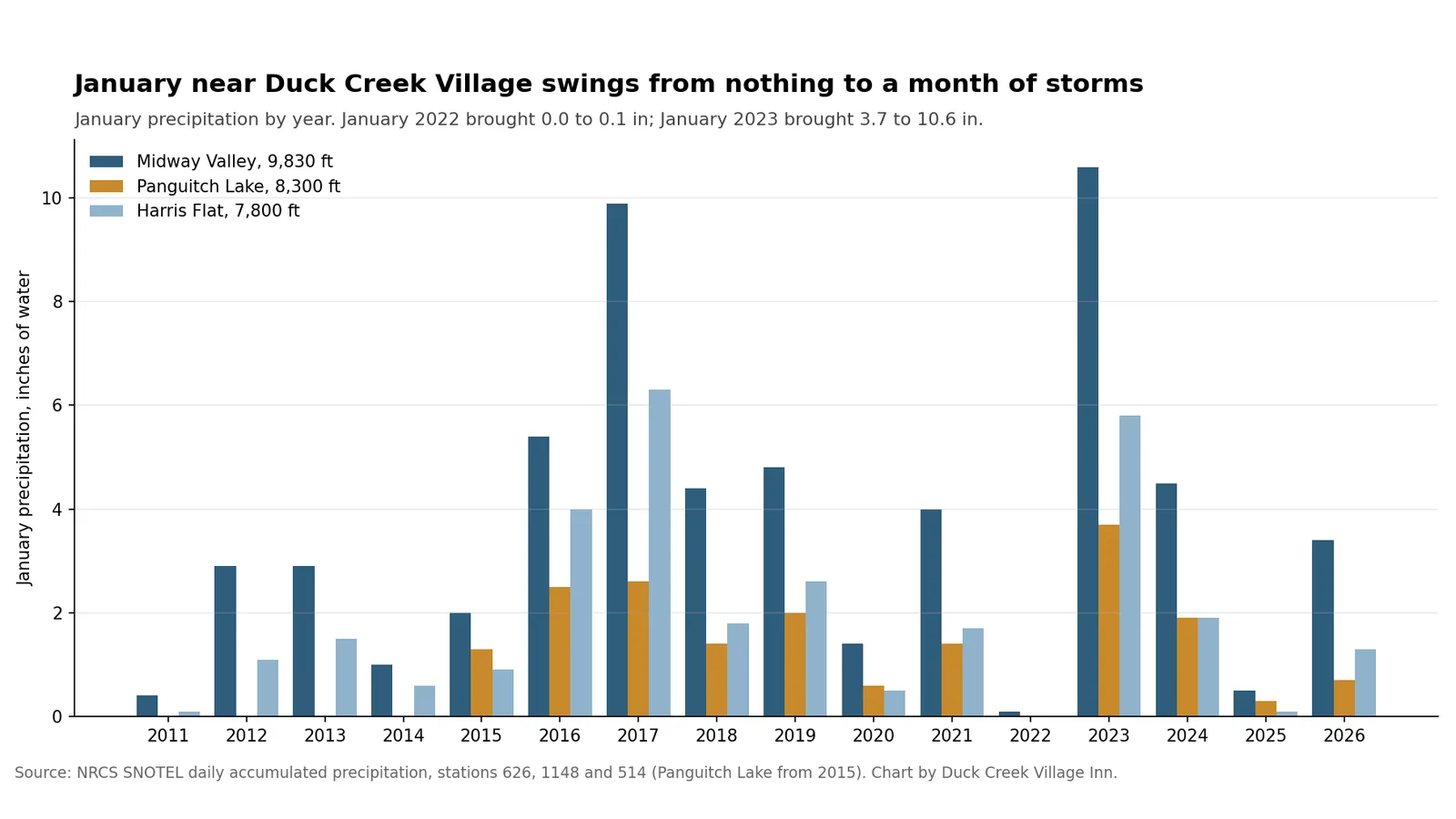
January precipitation by year at NRCS SNOTEL stations 626, 1148 and 514, 2011 to 2026. Chart by Duck Creek Village Inn from public data.
Near village height, the median snow depth grows from 8 or 9 inches on New Year’s Day to 14.5 inches on January 31. Snow sat on the ground on January 1 in 13 of 16 years at Harris Flat, and the summit had snow on that date every year. Martin Luther King Jr. Day falls on January 18, 2027, and Harris Flat had snow on that Monday in 14 of the last 16 years, with a median of 11 inches.
The two missing years are the last two. Harris Flat and Panguitch Lake had bare ground on January 31 in both 2025 and 2026, while the summit still held 22 to 40 inches. Check our snow report before you pack snowshoes, and read our winter guide for Highway 14 driving, chains and the groomed ski loops at Deer Hollow.
Cedar Breaks and the valley towns in January
Cedar Breaks closes to cars for the whole month. The National Park Service shuts SR-148 from mid November to mid May on average, and you can still reach Point Supreme, Sunset View and Chessman Ridge by snowmobile, cross-country skis or snowshoes. North View Overlook stays reachable by car on SR-143 from the Brian Head side, though storms can close that road for several days at a time.
| January normal, 1991 to 2020 | High and low |
|---|---|
| Cedar City, 5,590 ft | 42.8F and 18.0F |
| Kanab, 4,900 ft | 49.4F and 24.9F |
| St. George, 2,857 ft | 54.0F and 28.4F |
| Las Vegas | 58.5F and 40.5F |
| Phoenix | 67.6F and 46.0F |
The Las Vegas January normal low of 40.5F matches the average January afternoon at the stations near the village. Cedar City, 2,700 feet below Panguitch Lake, runs about three degrees warmer by day and two at night.
One valley runs the other way. Panguitch, at 6,615 feet on the Bryce road, averages a January low of 8.1F, seven and a half degrees colder than Panguitch Lake 1,700 feet higher. For a mountain stay in a warmer month, our cabins and rooms sit at 8,464 feet on Highway 14.
Quick answers about January in Duck Creek Village
Is January the coldest month in Duck Creek Village? Yes, on average. January has the lowest average high at all four nearby stations and the lowest average low at three, though the single coldest night of the winter falls in February more often.
How cold does it get at night in January? Lows average 16 to 17F on the slopes and 9F in the Harris Flat meadow, which drops to zero or below on six or seven nights. The January record there is minus 19.5F.
Is there snow in Duck Creek Village in January? In most years, yes. The median depth near village height runs 8 to 9 inches on January 1 and 14.5 inches by January 31, but 2025 and 2026 both ended January with bare ground at village height.
Will there be snow for Martin Luther King Jr. Day weekend? Odds favor it. Harris Flat had snow on the ground on that Monday in 14 of the last 16 years, and the summit in all 16.
Can you drive to Cedar Breaks in January? SR-148 stays closed to cars until mid May on average. You can still drive to North View Overlook on SR-143 in most weather and reach the other viewpoints on skis, snowshoes or a snowmobile.
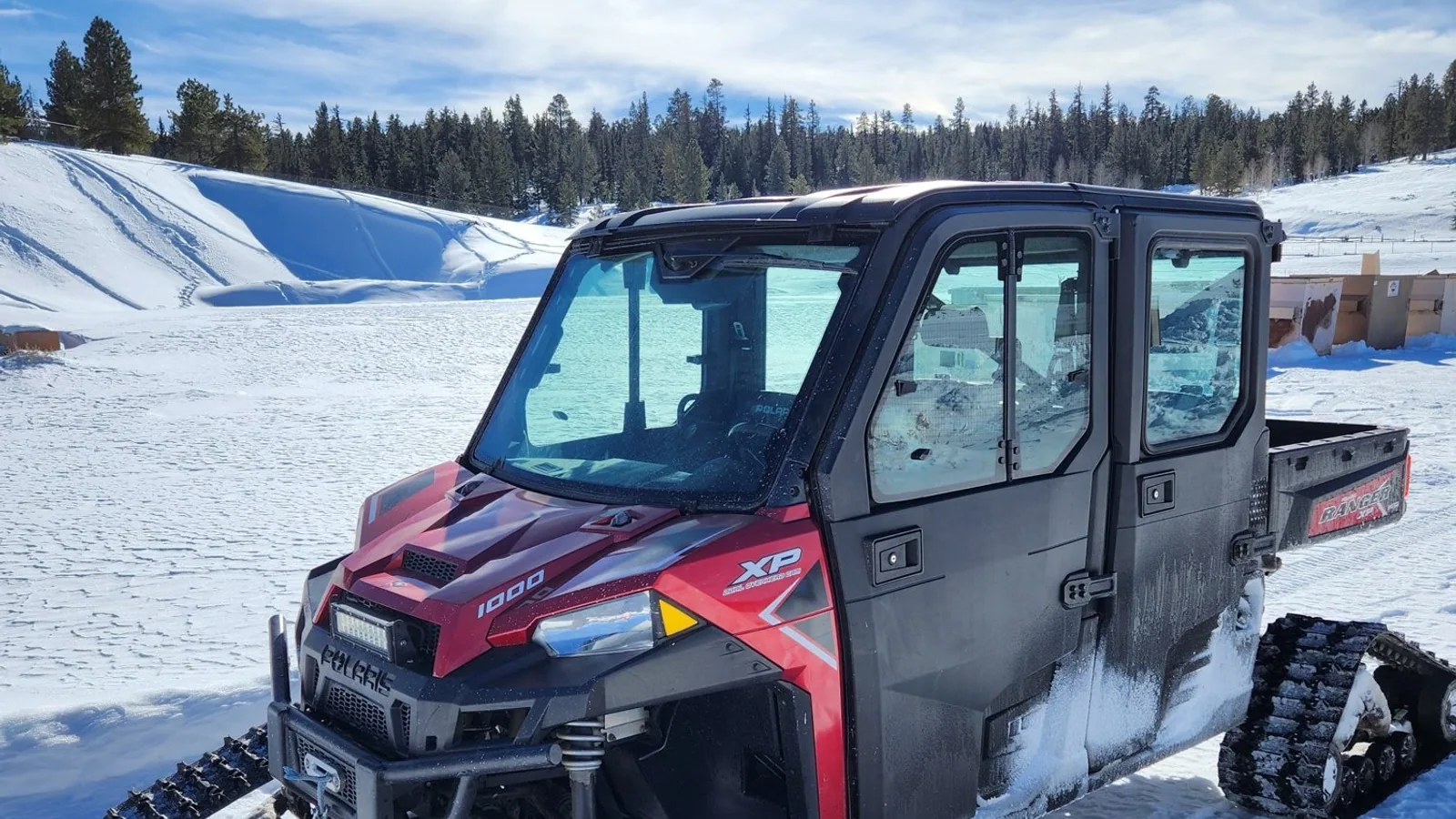
Hero photo: a tracked side-by-side on packed winter snow, from the Duck Creek Village Inn image library.