Snowmobiling from Duck Creek Village: The Cedar Mountain Snowmobile Complex
Eight groomed trails, nearly 100 miles by the agencies’ count, starting in the village. Where they go, where to park, what the rules are, and how to read the snow.
The forest that fills with side-by-sides in July is groomed for snowmobiles from about Christmas to the end of March. The Cedar Mountain Snowmobile Complex covers the plateau between Duck Creek Village and Brian Head, the Dixie National Forest grooms it with the Utah Division of Outdoor Recreation and Brian Head Town, and the longest trail in the system runs through the village. Most winter guests are here for it.
This page is the one we wished existed when we started answering the front-desk questions: which trails go where and how long they are, which pull-offs are plowed, what Utah asks of a rider on a sled (less than it asks on an ATV), the one rule inside Cedar Breaks that costs people real money, and an honest answer on tracked side-by-sides. The season-level picture, with skiing, snowshoeing, and ice fishing, is on our winter in Duck Creek guide.
Winter at a glance
Groomed miles
The Forest Service and the state say "nearly 100 miles." The official map legend adds up to 78.8. Either way, more than a long weekend covers.
Named trails
8 groomed trails, from the 3.1-mile High Mountain to the 20.5-mile Duck Creek Trail that starts in the village.
Elevation
About 8,000 feet at the low end to nearly 11,000 feet on the Brian Head Trail. The village sits at 8,400.
Season
Typically late December to March, set by snowpack rather than the calendar. The Cedar Breaks route has opened as early as late November and as late as January 2.
Education card
Adults 18 and over need no Utah OHV education card on a snowmobile. Riders under 18 need the youth snowmobile certificate.
Out-of-state sleds
Utah non-resident OHV permit, $35 per machine for 12 months, bought online before you ride. Rented Utah sleds are already covered.
Grooming report
grooming.snowut.com lists the complex as "Cedar MTN. - East Fork." Read it the morning you ride; groomers run at night and reports update about weekly.
Fuel
Loose Wheels at 835 E Movie Ranch Road is the only pump in the village, daily 9 to 6, gas and diesel, and a Polaris dealer if a sled needs a part.
The winter map
Groomed trails in blue over the summer trail network. The village is at the center; Midway and the Cedar Breaks route are to the northwest, Strawberry Point and Lars Fork to the south, Brian Head at the top. Tap the map to move around it.
Legend
Routes
Forest Service 4x4 OHV route
OHV route, 72 inches or less
OHV only
Open forest road
Featured ride from the inn
Groomed snowmobile trail (winter)
Trail markers
5Easy (green circle)
52Intermediate (blue square)
57Expert (black diamond)
One digit is a loop; two digits is a spur of that loop (52 branches off Loop 5).
Points
Duck Creek Village Inn
Fuel
ATV and UTV rentals
Destination or trailhead
Viewpoint
Campground or camp
Groomed trails traced from the 2014 Forest Service and State Parks map; positions are approximate.
The 2014 map is still the current official download and the positions here were traced from it to within about 150 meters. Carry the paper map or a photo of it, and treat the grooming report, not this drawing, as the word on what is open this week.
The eight groomed trails
These are the only eight named trails on the official legend. Mileages are the legend figures; the Forest Service narrative rounds the whole system up to "nearly 100 miles," and an older State Parks brochure listed a slightly different set that summed to about 80. Descriptions paraphrase the official map, with its own words kept in quotes.
Cedar Mountain Snowmobile Complex groomed trails, with legend mileage, character, terrain notes, and access points
Moderate to hard at the top: steep, narrow, and prone to drifts. Turn around if the climb is drifted shut; the point has no railings and the wind is real.
Duck Creek Village via the Duck Creek Trail south of SR-14; Duck Pond pull-off, SR-14 milepost 27
Altitude is the challenge: thinner air for riders and engines, and weather that arrives faster than at the village. Play areas are open only where the map shows them.
Brian Head town; Mammoth Summit Trailhead off SR-143
The easiest trail in the complex and the best short ride for a nervous passenger. Pair it with the Brian Head Trail for a half day.
Brian Head town
Legend total
78.8
The agencies describe the complex as "nearly 100 miles" groomed; a county tourism site says 160, which we cannot confirm.
Strawberry Point Trail: the headline trip
If you ride one trail here, ride this one. The official map calls Strawberry Point "the definitive snowmobile trip of the season," and it earns it: 9.1 groomed miles that start wide and flat through the Strawberry Valley meadows, then tighten into "a steep, narrow climb as riders make their way along the last couple of miles to the incredible lookout." The lookout is the end of the Virgin River Rim, roughly 9,000 feet, with the cliffs dropping away toward Zion and no railings. "Drifting near the top of the trail does occur," the map adds, and it does: the last mile is different after every storm, and a drifted-shut climb is a reason to turn around, not a challenge. Ride it in the morning, before the wind gets up on the rim, and give it a half day from the village. In summer the same point is our Strawberry Point ATV ride.
Duck Creek Trail, 20.5 miles
The longest groomed trail in the complex and the one that starts in the village. It connects Duck Creek with Midway Valley to the north and Strawberry Point to the south, running "fairly narrow through some stretches" and opening into "beautiful open meadows of fresh powder in others." The map adds a plain request: "Please watch your speed in the narrow sections." Mostly moderate. The narrow wooded sections are where sleds meet head-on, so keep right and keep speed down.
Lars Fork Trail, 11.7 miles
The Forest Service calls Lars Fork "among the most scenic of the entire complex." It has mild grades and a string of overlooks with "spectacular views of the Virgin River Valley and Zion National Park" from the south rim of the plateau. Mild grades; suitable for most riders once they are comfortable on the Duck Creek Trail. Stop at the overlooks, not on the trail.
Navajo Lake Trail, 10.9 miles
Follows the southern shore of Navajo Lake on a trail the map describes as "wide and flat." A marked but ungroomed spur leaves the main trail at Dry Valley and heads for Cascade Falls; treat the spur as backcountry, not groomed trail. The easiest full trail for first-timers and passengers. The Cascade Falls spur is ungroomed and can be drifted in.
Brianhead Trail, 8.6 miles
Spelled "Brianhead" in the legend and "Brian Head Trail" in the narrative. It runs parallel to SR-143, gives snowmobile access to the town of Brian Head and the ski area, and "approaches 11,000 feet in elevation." The map notes "several side loops and play areas" along the way. Altitude is the challenge: thinner air for riders and engines, and weather that arrives faster than at the village. Play areas are open only where the map shows them.
Cedar Breaks Trail, 8.5 miles
Enters Cedar Breaks National Monument along the closed SR-148 and "provides winter access to many scenic overlooks." The map is emphatic: snowmobile travel inside the monument is allowed "only on the marked, groomed trail that follows the road. This is the only legal path through the monument." Easy grades on a buried highway, but zero tolerance for leaving the orange-pole route. Walk or snowshoe to the overlooks; fines run to $5,000.
Sage Valley Trail, 6.4 miles
A "narrow, wooded trail" that threads "through the aspen and mixed coniferous forest" between the bigger trails. Quiet, close, and the one where you are most likely to meet another sled on a blind bend. Technically easy, but narrow with limited sight lines. Ride it single file at conversation speed.
High Mountain Trail, 3.1 miles
A "wide, well-groomed trail located high in the Cedar Mountains" with "excellent views into Cedar Breaks National Monument." Brian Head Town grooms it to the High Mountain Overlook, and the map calls it "a great trail for riders of all abilities." The easiest trail in the complex and the best short ride for a nervous passenger. Pair it with the Brian Head Trail for a half day.
Trailheads and where to park
The inn is the base. There is plenty of parking for trucks and trailers, Duck Creek Adventures rents sleds directly across the street, and the Duck Creek Trail runs through the village. In a normal winter the subdivision roads around the inn are snow-covered and officially closed to cars for the season, which under Utah law makes them legal for snowmobiles; you unload at the inn and ride to the trail. When the village streets are plowed and bare, do not ride the pavement. Trailer three minutes west to the Duck Pond pull-off, ten minutes to the Navajo Lake pull-off, or fifteen to twenty to the Midway lot and start there.
Two of the pull-offs below come from the Cedar Mountain Nordic Ski Club’s parking notes rather than from UDOT or the Forest Service, and are marked as such. They are plow-outs on a state highway, not signed trailheads, so how much room there is depends on when the plow last came through.
Duck Creek Village
Walk out the door
The village itself. The Duck Creek Trail runs right through town, and subdivision roads that are officially closed to cars for the season are legal to ride on a sled.
Trucks and trailers park at the inn. When Movie Ranch Road and the side streets are bare, trailer five minutes to a pull-off instead of riding pavement.
Trails: Duck Creek, Strawberry Point, Lars Fork
Duck Pond pull-off
About 3 minutes west
SR-14 at about milepost 27, the west edge of the village by Duck Creek Pond.
A plowed highway pull-off, not a lot. Room for a few trucks with trailers when UDOT has been through.
Trails: Duck Creek, Strawberry Point
Milepost from the Cedar Mountain Nordic Ski Club, not an official trailhead listing.
Navajo Lake pull-off
About 10 minutes west
SR-14 between mileposts 25 and 26, near the Navajo Lake Road turnoff.
Plowed shoulder staging area used by most riders heading for the lake. Fills on holiday weekends; arrive before 10.
Trails: Navajo Lake
Milepost from the Cedar Mountain Nordic Ski Club, not an official trailhead listing.
Midway Trailhead
About 15 to 20 minutes west
The junction of SR-14 and SR-148, where the Cedar Breaks road is gated for winter.
Plowed lot maintained by UDOT except during and right after storms. Trailers fit. Point Supreme is 3.5 miles up the buried highway.
Trails: Cedar Breaks, Duck Creek (north end)
Mammoth Summit Trailhead
An hour or more; the winter drive loops around to SR-143 by way of Panguitch Lake
Just off SR-143 at the north gate of the Cedar Breaks road, between Brian Head and Panguitch Lake.
Small plowed area; the Park Service says trailers are not permitted and cars should park diagonally. Point Supreme is 4.1 miles.
Trails: Cedar Breaks, Brianhead
Brian Head town
About 1 hour 15 minutes in winter
Brian Head on SR-143, reached in winter by I-15 to Parowan or US-89 to Panguitch.
Several town lots; the Park Service and the town both say to check locally. Thunder Mountain Motorsports stages tours from its shop.
Trails: Brianhead, High Mountain, Cedar Breaks (via Mammoth Summit)
Rules that are different in winter
Utah treats a snowmobile more gently than an ATV in some ways and more strictly in others. The statute is Utah Code Title 41, Chapter 22; the Division of Outdoor Recreation’s 2025 safety brochure restates it in plain English. The points that matter on Cedar Mountain:
No education card for adults on a sled. Utah Code 41-22-31(4) exempts anyone 18 or older operating a snowmobile from the OHV education requirement that applies to ATVs and side-by-sides. Riders under 18 need the youth snowmobile certificate, and a driver under 18 without a license must stay within sight of a supervising adult.
Helmets under 18. Anyone under 18 operating or riding a snowmobile on public land must wear a DOT-rated helmet (41-22-10.8). Every rental shop here requires them for minors and hands them out to everyone.
Sleds may use roads that are closed for the season. 41-22-10.4 lets snowmobiles run on streets and highways "officially closed for the season" because plowing has stopped. That is the legal basis for riding the buried SR-148 through Cedar Breaks and the unplowed subdivision roads around the village.
No riding on open highways. SR-14 is plowed and open all winter, so it is off limits. A sled may cross it only after a complete stop, yielding to traffic, at a right angle (41-22-10.3). Riding the shoulder is a citation and, in a whiteout, a good way to meet a plow.
Cedar Breaks: the orange poles or nothing. Inside the monument, snowmobiles are allowed only on the marked, groomed route that follows SR-148. The Park Service fines violators up to $5,000 and impounds machines. Park at a pullout and walk or snowshoe to the overlooks. When snowpack is thin, the Park Service closes the monument to sleds entirely; it did so in December 2025 until enough snow fell.
Wheeled vehicles 800 pounds and up are banned from groomed trails. 41-22-12.1 makes it an infraction to drive a wheeled vehicle of 800 pounds or more on any snowmobile trail the state marks or grooms. That covers every side-by-side on wheels. Tire ruts freeze into hazards, and the groomer crew has to go back out to fix them.
Ashdown Gorge Wilderness and Deer Hollow are closed to motors. The wilderness west of Cedar Breaks bans all motorized and mechanical travel. Deer Hollow, the Nordic ski area four miles west of the village on SR-14, is closed to snowmobiles with the boundary signed.
There is no over-snow map for the Dixie. The Forest Service publishes no over-snow vehicle use map for this forest, and cross-country travel on land not designated for it is an infraction (41-22-12.2). Stay on the marked groomed trails and the marked ungroomed spurs. The summer MVUM is not the winter rule book.
Registration. A sled needs a current home-state registration plus the Utah non-resident permit, or a Utah registration. Snowmobiles are exempt from the new Utah OHV license-plate rule and from the spark-arrestor requirement that applies to ATVs.
The summer rulebook, with the education card, the SR-14 street-legal question, and Kane County’s village-road rules, is on our rules and safety page.
Tracked side-by-sides
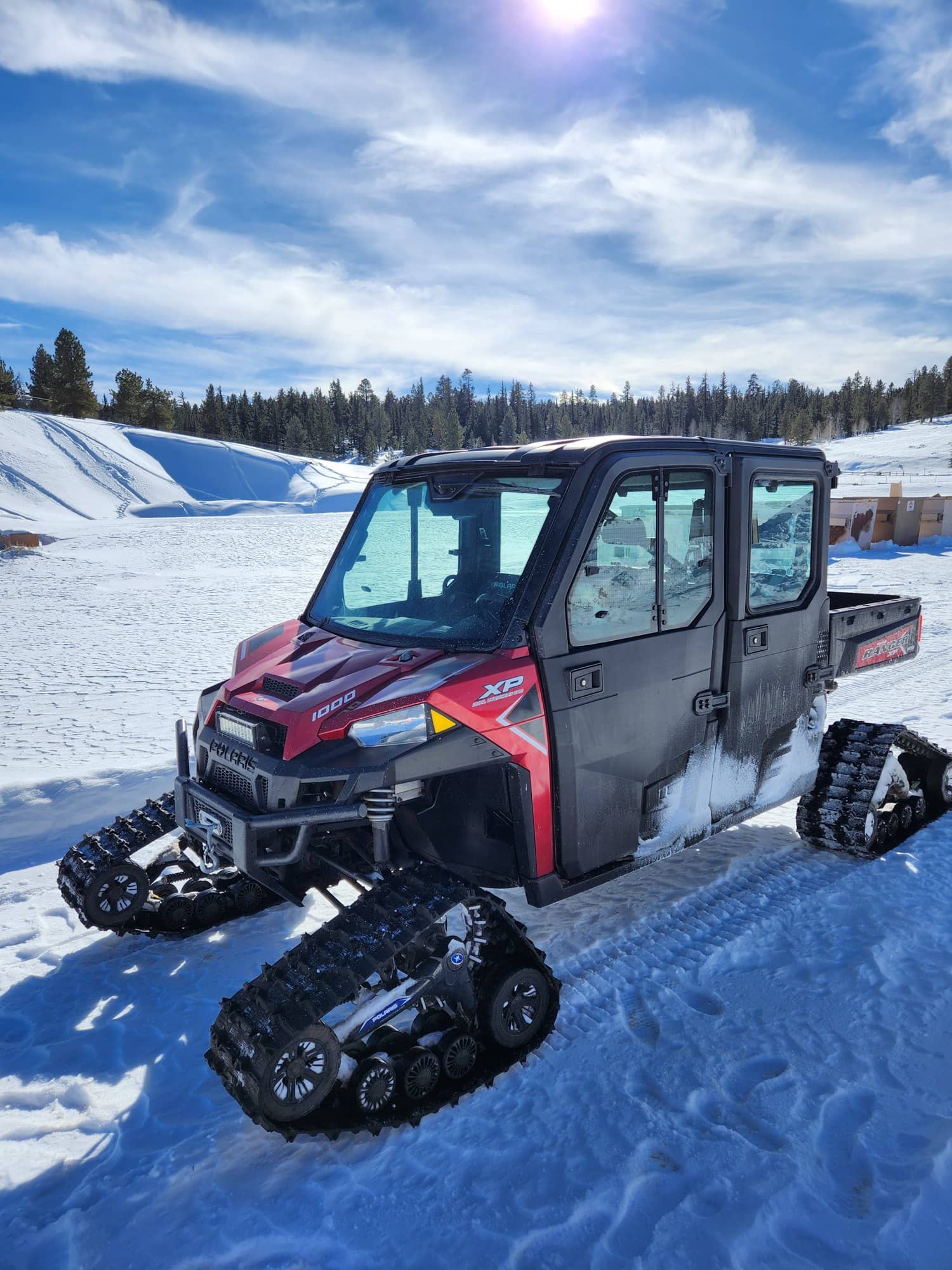
Every winter someone asks whether they can put tracks on the RZR and ride the groomed trails. Our answer, as innkeepers who watch the machines come and go: tracked side-by-sides are not recommended for the snowmobile routes, but they are a good way to get around town.
Here is the honest legal picture. Utah Code 41-22-12.1 bans "a wheeled vehicle with a gross vehicle weight of 800 pounds or more" from any groomed snowmobile trail. It says nothing about tracked vehicles, and the state’s definition of a snowmobile is broad enough ("steered and supported in whole or in part by skis, belts, cleats, runners, or low pressure tires") that a tracked machine may or may not fit it. We found no Forest Service or state ruling either way for Cedar Mountain. What we do know: the complex is groomed for snowmobiles, not side-by-sides; a tracked UTV is far heavier and wider than a sled and leaves a different surface behind it; and the village rental shops require their machines to stay on the groomed trails and do not rent tracked UTVs in winter. Some Utah trail systems, like Ephraim Canyon in Sanpete County, are groomed for tracked UTVs on purpose. This one is not.
So: use tracks for what they are good at. Plowed and unplowed village roads, reaching a cabin on a road the county has stopped plowing, running to Loose Wheels for fuel, an evening lap around Aspen Mirror Lake. A road "officially closed for the season" is legal ground for any over-snow machine under 41-22-10.4. Leave the groomed trails to sleds. If you want to take a tracked machine onto the groomed system anyway, call the Utah Division of Outdoor Recreation first at 801-538-5500 and ask; they manage the grooming program and their answer, not ours, is the one that counts with a ranger.
A tracked side-by-side in the village. Good for getting around town in winter; leave the groomed snowmobile trails to sleds.
Rentals and guided tours
Three shops on Movie Ranch Road rent snowmobiles in season, all within a short walk of the inn and one directly across the street. None of them requires the Utah education card of an adult on a sled, but every one requires helmets for minors and expects the machine back on groomed trails. In Brian Head, Thunder Mountain Motorsports runs guided tours rather than rentals, which is the answer for a group with 16- and 17-year-old drivers. Rates below are the operators’ own published figures as of September 2026; call to confirm before you count on them.
825 Movie Ranch Road, Duck Creek Village. Directly across the street.
Winter fleet
Grand Touring two-up snowmobiles and single-rider sleds, self-guided on the groomed trails.
Rates
Two-up sled published at $200 for 2 hours, $250 for 4 hours, $325 for 8 hours; single-rider sleds from $225. Fuel is billed on return.
Rules
Drivers 25 and older with a license and credit card; $500 damage deposit per machine; helmets required under 18; all sleds must stay on groomed trails; $150 recovery fee if you get stuck or flood the machine.
539 N Highway 143, Brian Head. About 1 hour 15 minutes in winter.
Winter fleet
Guided snowmobile tours only, covering Brian Head, the Dixie National Forest, and the Cedar Breaks route; no unguided rentals.
Rates
Published at $150 per machine for 1.5 hours, $235 for 3 hours, $360 for 6 hours, plus $30 to $60 per passenger. Owners may follow a tour on their own sled for $20.
Rules
Drivers 16 and older with parental consent for minors; passengers 5 and older; helmets, fuel, and oil included; 48-hour cancellation.
Operator facts checked against each business’s own website in September 2026. Fleets and hours change fast up here, and a shop may hold its sleds back until the base is deep enough, so call the week before. Summer machines and the full comparison are on the rentals and tips page; how we set up riding groups is on snowmobile lodging in Duck Creek.
Season, snow and how to check conditions
The season runs on snowpack. Grooming on Cedar Mountain usually starts once a solid base has built in late December and wraps up in March, though the high trails can hold into April; the Deer Hollow ski area on the same mountain says its season "usually starts mid-December and wraps up mid to late March," which is a fair description of the snowmobile season too. The Cedar Breaks route is the bellwether: the Park Service closed SR-148 and opened it to sleds on November 27 in 2024, but not until January 2 in 2026 after a dry December, and in 2023 the route stayed open until April 27.
Snowfall climbs steeply with elevation. Climate aggregators put the village, at 8,400 feet, near 75 to 80 inches a year, and Cedar Breaks, above 10,000 feet, around 245 inches. Neither figure is an official measurement, but the gradient is real, and it is why the Duck Creek Trail can be thin through the village while Midway Valley is buried. The SNOTEL stations that bracket the complex:
Midway Valley, 9,830 ft. Closest to the Midway Trailhead and the Cedar Breaks route; the station our snow report reads for the high trails.
Castle Valley, 9,600 ft. North of the complex toward Brian Head.
Webster Flat, 9,150 ft. West of Navajo Lake on the SR-14 summit.
Brian Head, 10,040 ft. Top of the Brian Head Trail country.
Harris Flat, 7,800 ft. Below the village to the south; the low end of what our snow report shows.
Check these before you ride
Snow report: live depth at the SNOTEL stations above and below the village, in inches or centimeters.
Road conditions: UDOT alerts, the SR-14 camera, and the traction-law status for the drive up.
Cedar Breaks winter access: whether SR-148 has closed for the season and whether the monument is open to sleds.
Utah Avalanche Center: the official map says it plainly, "If you don’t know, don’t go." The center does not issue a regular forecast for this corner of the state, so read the observations and stay off steep, wind-loaded slopes.
Storms and the drive up
SR-14 is plowed all winter and open most days. It closes for hours, occasionally overnight, during and just after big storms while crews clear Cedar Canyon, and when UDOT posts the traction law, two-wheel-drive cars need snow tires with the mountain-snowflake symbol or chains and AWD needs M+S tires on all four corners. Carry chains from December through March even if they never leave the truck. A trailer on the canyon grades in fresh snow is slow work; if it is dumping, have lunch in Cedar City and let the plows go first. Our winter access page has the full driving brief, and there is no cell signal on most of the complex, so download maps and tell someone your route before you leave the village.
Pair it with Brian Head
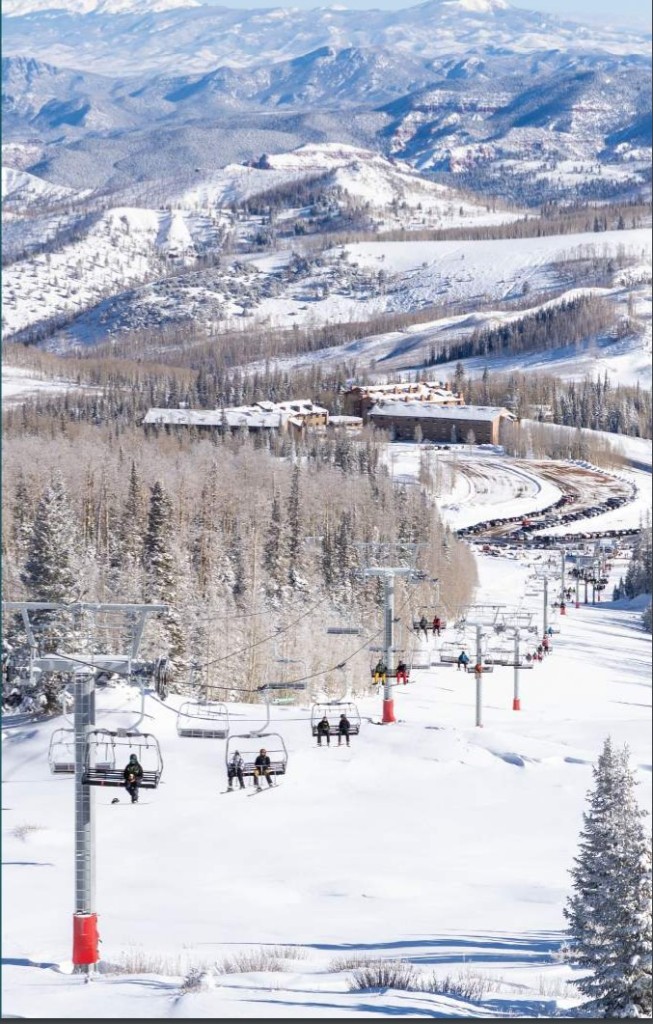
The north end of the complex is Brian Head country: the Brian Head Trail parallels SR-143 up to nearly 11,000 feet and into town, and the short High Mountain Trail climbs to an overlook into Cedar Breaks that the map rates for "riders of all abilities." Brian Head Town helps groom both. A good pattern for a long weekend is two days on the Duck Creek side, then one day north for a ski or tubing day at Brian Head Resort, the highest base elevation in Utah at 9,800 feet, or a guided sled tour with Thunder Mountain Motorsports if part of the group wants someone else to lead.
By sled, Brian Head is a long day across the complex through Cedar Breaks on the marked route. By car in winter it is about 1 hour 15 minutes, because the 35-minute SR-148 shortcut is under the snow you came to ride: west on SR-14 to Cedar City, north on I-15 to Parowan, and up Parowan Canyon on SR-143. Our Brian Head guide covers lifts, tubing, and the town.
September 2026
Official sources behind this guide
We live in the village year-round and answer these questions at the front desk all winter. Trail names, mileage, and the quoted descriptions come from the Dixie National Forest and Utah State Parks complex map; the rules from Utah Code Title 41, Chapter 22 and the Division of Outdoor Recreation's 2025 brochure; Cedar Breaks rules and dates from the National Park Service; operator facts from the operators' own pages. Where official sources disagree, we say so rather than pick one. Grooming and snow change weekly, so check the live sources before you commit a day.
What guests ask before a winter trip to Cedar Mountain.
Can you snowmobile straight from Duck Creek Village Inn?
Yes, once the village side roads are snow-covered and closed to cars for the season. The Duck Creek Trail, the longest groomed trail in the Cedar Mountain complex at 20.5 miles, runs through the village and connects north to Midway Valley and south to Strawberry Point and Lars Fork. When the streets are bare, trailer three minutes to the Duck Pond pull-off or ten minutes to the Navajo Lake pull-off on SR-14. Trucks and trailers park at the inn.
How many miles of groomed snowmobile trail are there at Duck Creek?
The Forest Service and Utah State Parks describe the Cedar Mountain Snowmobile Complex as "nearly 100 miles" of groomed trail. The eight trails on the official map legend add up to 78.8 miles. A county tourism site claims 160 miles, which we cannot confirm from any official source.
Do I need the Utah OHV education card to ride a snowmobile?
Not if you are 18 or older. Utah Code 41-22-31(4) exempts adults on snowmobiles from the education requirement that applies to ATVs and side-by-sides. Riders under 18 need the youth snowmobile certificate and a DOT helmet. Guided tours are exempt for everyone, which is why a Brian Head tour is the simplest way to put a 16- or 17-year-old on a sled.
Do I need a permit for my out-of-state snowmobile in Utah?
Yes. A snowmobile registered outside Utah needs a Utah non-resident OHV permit, $35 per machine, valid 12 months, bought online through the Division of Outdoor Recreation before you ride on public land. If you rent in the village, the shop’s Utah-registered sled is already covered.
Can I ride a snowmobile through Cedar Breaks National Monument?
Only on the marked, groomed route that follows the closed SR-148, flagged with orange snow poles. It is the only legal snowmobile path through the monument. Leaving the route onto the meadows carries fines up to $5,000 and the machine can be impounded. Park at a pullout and walk or snowshoe to the overlooks. The Park Service closes the monument to sleds when snowpack is too thin to protect the meadows.
Can I take a tracked side-by-side on the groomed snowmobile trails?
Our advice is no. Utah law bans wheeled vehicles of 800 pounds or more from groomed snowmobile trails and is silent on tracked machines, the Cedar Mountain complex is groomed for snowmobiles, and the village rental shops require their sleds to stay on the groomed trails. A tracked side-by-side is a good way to get around town and reach a cabin on an unplowed road. Before taking one onto a groomed trail, call the Utah Division of Outdoor Recreation at 801-538-5500.
When is snowmobile season in Duck Creek Village?
Typically late December through March, but it runs on snowpack, not dates. The Cedar Breaks route opened November 27 in 2024 and not until January 2 in 2026 after a dry December; it has stayed open into late April in a big year. Check the grooming report and our snow report before you book, and keep a Brian Head ski day in reserve.
Book a winter basecamp
Stay at Duck Creek Village Inn: trailer parking, sled rentals across the street, the Duck Creek Trail through the village, and a warm room when the light goes.