Duck Creek Campground at the village, three campgrounds on Navajo Lake, free dispersed sites at Uinta Flat, and the truth about nights at 8,400 feet
Camping around Duck Creek comes in three flavors. Duck Creek Campground is the big Forest Service campground at the village itself, with its entrance on Highway 14 beside Duck Creek Pond: 86 single sites, 7 doubles, and 4 group sites in five loops of spruce and aspen at 8,400 feet, $30 a night, open from late May to late September. Twelve to twenty minutes west, three smaller campgrounds sit on the south shore of Navajo Lake, closer to the water and quieter. And at Uinta Flat and Lava Flat, the Forest Service keeps numbered dispersed sites that cost nothing at all.
They share the same ground rules: no hookups, no showers, a 14-day stay limit, water that runs only in the core season, and nights that drop into the 40s in August. Most sites can be reserved at recreation.gov or by phone at 877-444-6777, with some held first-come, first-served. The fees below are the 2026 recreation.gov rates; verify when you book. If the trip is built around the lake, read this alongside our Navajo Lake page and the fishing guide.
We are a hotel, not the campground
Duck Creek Village Inn is a hotel and cabin property in Duck Creek Village. We do not own, run, or take bookings for any of the Forest Service campgrounds around Duck Creek Village. Our front desk cannot check campsite availability, hold a site, change a camping reservation, or look one up — we have no access to the system. Please use the numbers below instead, and our apologies if a search sent you to us first.
What we can tell you is what the road and the weather are doing, and we do have rooms and cabins 15 minutes away if the campgrounds are full.
The company that runs these campgrounds for the Forest Service. Call them about a site you are in, a fee question, or anything a camp host would handle.
Duck Creek Campground, entrance on Highway 14 beside Duck Creek Pond at the west edge of the village
Season
Late May through September; Duck Creek Campground runs May 22 to September 28 in 2026
Fees (2026)
$30 single site, $60 double, $23 walk-in tent at the lake campgrounds, $100 group at Duck Creek
Reservations
recreation.gov or 877-444-6777; some sites first-come, first-served; 3-night minimum on holiday weekends
Free camping
Two designated dispersed areas, Uinta Flat off Strawberry Point Road and Lava Flat up Mammoth Road; plus general dispersed camping across much of the forest
Hookups and showers
None at any Forest Service campground; dump stations at Duck Creek, Te-Ah, Spruces, and Panguitch Lake North
Nights
Cold at 8,400 feet even in August; bring a bag rated well below the daytime forecast
Campfires
Only where current fire restrictions allow; often limited to campground fire rings, never assume last month's rules
The campgrounds, compared
Duck Creek Campground is the one at the village; the Navajo Lake trio is the quieter, closer-to-the-water alternative. Everything else here is worth knowing when the near ones are full, and the two dispersed areas cost nothing. Sorted by drive time from the inn.
Distances traced along the real roads from the inn. Max RV length is the Forest Service and Park Service permitted length, not the driveway length that reservation-site search results publish. A dash means no agency publishes that figure, and we would rather show you the gap than fill it in.
Campground
From the inn
Elevation
Sites
Fee
Max RV
Water
Status today
Duck Creek CampgroundDixie National Forest
2.1 mi 5 min
8,400 ft
97 Reservable, some first come
$30
45 ft Median site 35 ft; the 45 ft sites are in Loop A
YesMemorial Day to Labor Day
Open now Published season: May 22 to September 28.
Navajo Lake CampgroundDixie National Forest
6.6 mi 12 min
—
27 Most first come, first served
$30
60 ft Median 40 ft; eleven walk-in tent sites take no vehicle
YesSpigots
Closed for the season Published season: May 22 to September 7.
Spruces CampgroundDixie National Forest
7.5 mi 15 min
—
28 Reservable, some first come
$30
75 ft Median 45 ft; site 07 in the Lower loop is the long one
YesPeak season only
Closed for the season Published season: May 22 to September 7.
Te-Ah CampgroundDixie National Forest
9.6 mi 20 min
9,200 ft
41 Reservable, some first come
$30
58 ft Median 48 ft, over 30 sites at 44 ft or more
YesPiped from a spring
Closed for the season Published season: May 22 to September 7.
Point Supreme CampgroundNational Park Service, Cedar Breaks
15.6 mi 25 min
10,000 ft
25 Reservation only
$30
40 ft Hard cap. For a larger motorhome ask for site 1, 8, 15 or 21
YesSeasonal, plus free hot showers
Closed for the season Published season: June 19 to September 18.
Cedar Canyon CampgroundDixie National Forest
17.4 mi 27 min
8,100 ft
18 Reservable, some first come
$25
40 ft Median 30 ft. The tightest of these for a trailer
This is the campground at the village. The entrance is on Highway 14 just west of town, beside Duck Creek Pond, and everything else on this page is a drive away. It is the largest campground in this guide, five loops lettered A through E spread through spruce, fir, and aspen at 8,400 feet, with a mix of flush and vault toilets, drinking water from Memorial Day through Labor Day, and a dump station at the entrance. No hookups, no showers.
Two things set it apart. Off-highway vehicles are allowed in loops C, D, and E, so riders on the Markagunt system can leave straight from camp (our ATV guide covers the routes), which also makes those loops the noisy ones; ask for A or B if you want quiet. And it sits a short walk from the pond, the village restaurants, and the general store, so it is the campground for people who want the forest without giving up a hot breakfast in town. Holiday weekends carry a 3-night minimum.
Duck Creek Pond, at the campground entrance. The stocked pond is the campground's front yard.
The Navajo Lake campgrounds
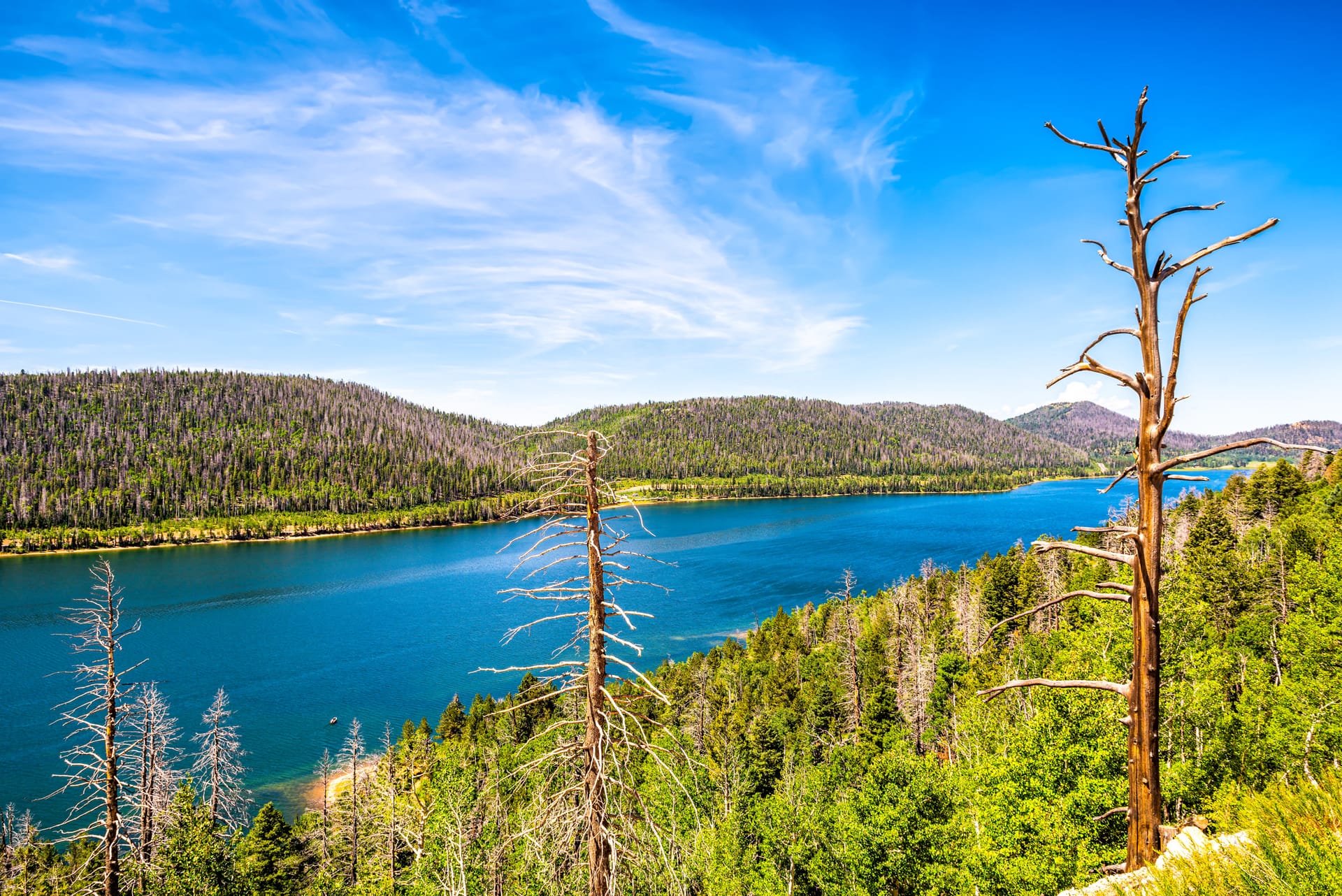
Navajo Lake Road leaves Highway 14 about four miles west of the village, wraps around the east end of the lake, and runs along the south shore. Three Forest Service campgrounds sit along it, in order from the highway: Spruces at about 2.5 miles, Navajo Lake at 3.5, and Te-Ah at 5.5. All three close in early September, earlier than Duck Creek, and the road itself goes unplowed in winter.
Navajo Lake Campground
The one on the water. Sites sit close to the shore, there is a boat ramp inside the campground, and 11 of the 27 sites are walk-in tent sites, which are quieter, cheaper at $23, and closest to the lake. Mostly first-come, first-served, so arrive early on a summer Friday. If you plan to fish from camp, our fishing guide covers what is in the lake and the one-trout-over-22-inches rule.
Spruces Campground
The first campground you reach, about 2.5 miles down the road on the south shore, with roughly two dozen sites under the spruce. Flush toilets, seasonal water, a dump station, and a $23 tent rate that makes it one of the cheaper ways to wake up near the water.
Te-Ah Campground
The highest campground in this guide at 9,200 feet, about 5.5 miles in near the west end of the lake. Around 40 sites plus one group site for up to 20 people, with spring-fed piped water, paved access roads, flush and vault toilets, and a dump station. ATVs are prohibited inside the campground, which keeps it noticeably quieter than Duck Creek.
Navajo Lake from the south shore, where all three campgrounds sit.
Farther out: Cedar Breaks, Cedar Canyon and Panguitch Lake
More options within striking distance, useful when the Navajo Lake campgrounds are full or the trip leans toward Cedar Breaks, Cedar City or Panguitch.
Point Supreme, Cedar Breaks National Monument
The highest campground anywhere near the village, at about 10,000 feet on the rim, and the only one on this page run by the Park Service rather than the Forest Service. Twenty-five minutes up Highway 14 and 148. Twenty-five sites, reservation only, hot showers, and no dump station. The monument entrance fee applies on top of the site fee, and the season is the shortest here: it opened on 19 June this year and closes on 18 September. Our Cedar Breaks guide covers the overlooks, the wildflowers and the dark-sky programs; the conditions page tracks whether the road is open.
Cedar Canyon Campground
At 8,100 feet, 13 miles east of Cedar City on the west side of the plateau, so the far side of the mountain from Duck Creek. It suits trips split between Cedar City and the high country. ATVs must stay trailered. The campground currently has no potable water because of construction, and a 20 percent fee reduction is in effect; check the Dixie National Forest alerts page before you go.
Panguitch Lake North and South
A pair of campgrounds at 8,400 feet on Highway 143, 16 miles southwest of Panguitch, beside the lake many locals rate as the best big-trout water in the region. North is the full-service side, with 39 single, 8 double, and 3 group sites, flush toilets, water, and a dump station. South is simpler: 18 tent-only sites, first-come only, with water and flush toilets. Our Panguitch Lake page has the lake detail.
Free and dispersed camping
Dispersed camping, meaning camping outside developed campgrounds, is allowed across much of Dixie National Forest around Duck Creek, and it is free. No reservations, no fees, and no services: you pack in everything, including water, and pack out everything, including trash.
There are two designated dispersed areas near the village, not one. Uinta Flat sits along Forest Road 064 off Highway 14 by way of Strawberry Point Road, and the road out to Strawberry Point carries on past it for the sunset view. Lava Flat is closer still, 1.7 miles up Mammoth Road, and is the shorter drive of the two. Sites at both are numbered and first-come, first-served, with no water and no toilets.
Being a numbered site in a designated area is not a formality. It is the thing that makes camping there legal inside the half-mile buffer the Forest Service draws around every developed campground.
The rules that matter
Stay limit: 16 days in any 60-day period within 10 miles of the same spot; developed campgrounds allow 14 days per 30
No dispersed camping within a half mile of developed campgrounds, trailheads, or administrative sites, except in designated numbered sites like Uinta Flat and Lava Flat
No camping or parking within 300 feet of signed water sources, and at least 300 feet from any stream
To reach a dispersed site you may drive no more than 150 feet off a designated route, and you should use a site that already exists rather than making a new one
Fire restrictions on this mountain are volatile. Stages tighten and relax as conditions change, sometimes more than once in a summer. Under stage restrictions, campfires are typically limited to Forest Service fire rings at developed campgrounds, which means no dispersed campfires at all, including at Uinta Flat.
None of the Forest Service campgrounds above have hookups, so no power, water, or sewer at the site, and no showers. Four have dump stations: Duck Creek, Te-Ah, Spruces, and Panguitch Lake North. At Duck Creek Campground the dump station sits at the entrance and drinking water runs Memorial Day through Labor Day, so a self-contained rig does fine there through the core season.
If you want a private RV park, the one in the village is Duck Creek Village RV (duckcreekvillagerv.com, 435-580-8185), listed in the Duck Creek Village Association directory. Hookup details are not published online, so call ahead to confirm what is available before you tow up the mountain.
Two things to sort out before you tow: check your rig length against the specific site on recreation.gov rather than assuming it will fit, and check road conditions on Highway 14. The climb out of Cedar City is long, the grades are real, and our live cams show what the village end of the road looks like right now.
What camping at 8,400 feet is actually like
Nights are cold, even in July and August. Everything on this page sits between 8,100 and 9,200 feet, and summer days that feel warm in the sun drop off fast once it sets. Bring a sleeping bag rated well below what the daytime forecast suggests, plus layers and a hat you can sleep in. Our Duck Creek weather page has the forecast for the village, not the valley floor.
July through September is monsoon season. Clear mornings, afternoon thunderstorms with lightning. Plan hikes and lake time early, and when thunder starts, get to the vehicle or a building and wait 30 minutes after the last clap. Our hiking guide lists the trailheads closest to each campground for the mornings.
Water is seasonal everywhere. Spigots run roughly Memorial Day to Labor Day at Duck Creek Campground and shut off outside each campground's core season; Cedar Canyon currently has none at all; dispersed areas never have any. Carry more than you think you need.
Book the popular weekends early. Duck Creek and Cedar Canyon carry a 3-night minimum on holiday weekends, so those dates go as blocks; reserve as soon as your dates open on recreation.gov. And check road conditions before towing a trailer up early or late in the season, when Highway 14 can still see snow.
Camping versus a cabin
We will be straight with you: we run an inn, so we are biased. But a lot of our guests are campers, and they come for the same forest, the same lake, the same trails. Where the inn earns its keep is the nights the mountain does not cooperate: the August cold snap, the third straight afternoon of monsoon rain, the fire restrictions that cancel the campfire half the trip was about. If part of your group loves tents and part of it loves hot showers, our cabins and rooms sit in the village a few minutes from Duck Creek Campground. Book the doubters a real bed and meet up for the day.
September 2026
Why trust this page
We are innkeepers in Duck Creek Village, not rangers. Fees, seasons, water availability, and fire restrictions all change; the sources below are what we checked in August 2026 and re-read in September, and they are where you should verify before you go. The Duck Creek Visitor Center on Highway 14 (open Friday through Monday, 10am to 3pm in season) and the Cedar City Ranger District at 435-865-3700 can answer anything this page cannot.
Quick answers for planning a camping trip around Duck Creek Village.
Is there a campground in Duck Creek Village?
Yes. Duck Creek Campground is a Dixie National Forest campground with its entrance on Highway 14 just west of the village, beside Duck Creek Pond, at 8,400 feet. It has 86 single sites, 7 doubles, and 4 group sites in loops A through E, flush and vault toilets, drinking water from Memorial Day to Labor Day, and a dump station at the entrance. Fees are $30 single, $60 double, and $100 group; the 2026 season runs May 22 to September 28; most sites can be reserved at recreation.gov or 877-444-6777.
Where can I camp near Duck Creek Village, Utah?
Duck Creek Campground at the village; Navajo Lake, Spruces, and Te-Ah campgrounds off Navajo Lake Road about 15 to 20 minutes west; free designated dispersed sites at Uinta Flat off Strawberry Point Road; and, farther out, Cedar Canyon Campground toward Cedar City and the two Panguitch Lake campgrounds.
Do I need reservations to camp at Duck Creek?
Most sites at Duck Creek Campground can be reserved at recreation.gov or 877-444-6777, with some held first-come, first-served. Navajo Lake Campground is mostly first-come, first-served, and Panguitch Lake South is entirely first-come. Duck Creek and Cedar Canyon carry a 3-night minimum on holiday weekends, so reserve those early.
Is there free camping near Duck Creek Village?
Yes. Uinta Flat, along Forest Road 064 off Highway 14 by way of Strawberry Point Road, is a designated dispersed camping area with numbered first-come sites, free, with no water or services. General dispersed camping is also allowed in much of Dixie National Forest, limited to 16 days in any 60-day period and subject to setback rules from campgrounds, trailheads, and water.
Can I have a campfire while camping near Duck Creek?
It depends on the fire restrictions in force, which change through the season. Under stage restrictions, campfires are typically allowed only in Forest Service fire rings at developed campgrounds, with no dispersed campfires permitted. Check the Dixie National Forest alerts page and utahfireinfo.gov before your trip.
When is camping season in Duck Creek, Utah?
Roughly late May through September. Duck Creek Campground's 2026 season runs May 22 to September 28; the Navajo Lake campgrounds close in early September and the others by mid September. Outside those windows the campgrounds are closed and the water is shut off.
Is there an RV park in Duck Creek, Utah?
Duck Creek Campground is a Forest Service campground that takes RVs, not an RV park; it has a dump station at the entrance but no hookups. The private option in the village is Duck Creek Village RV (435-580-8185), listed in the Duck Creek Village Association directory. Its hookup details are not published online, so call ahead.
Are there RV hookups in Duck Creek, Utah?
Not at the Forest Service campgrounds. None have hookups or showers, though Duck Creek, Te-Ah, Spruces, and Panguitch Lake North have dump stations. For hookups, call Duck Creek Village RV (435-580-8185) in the village to confirm what is available.
Rather Not Shiver at 2 a.m.?
Rooms and cabins at Duck Creek Village Inn put you minutes from the campgrounds, the lake, and the trails, with heat, hot showers, and a real bed after a cold night.